
How Much Does a Water Tank Cost in India?
Water tank costs vary by capacity, material, construction and installation. Understand the main price factors and how to budget for a water storage tank in India.
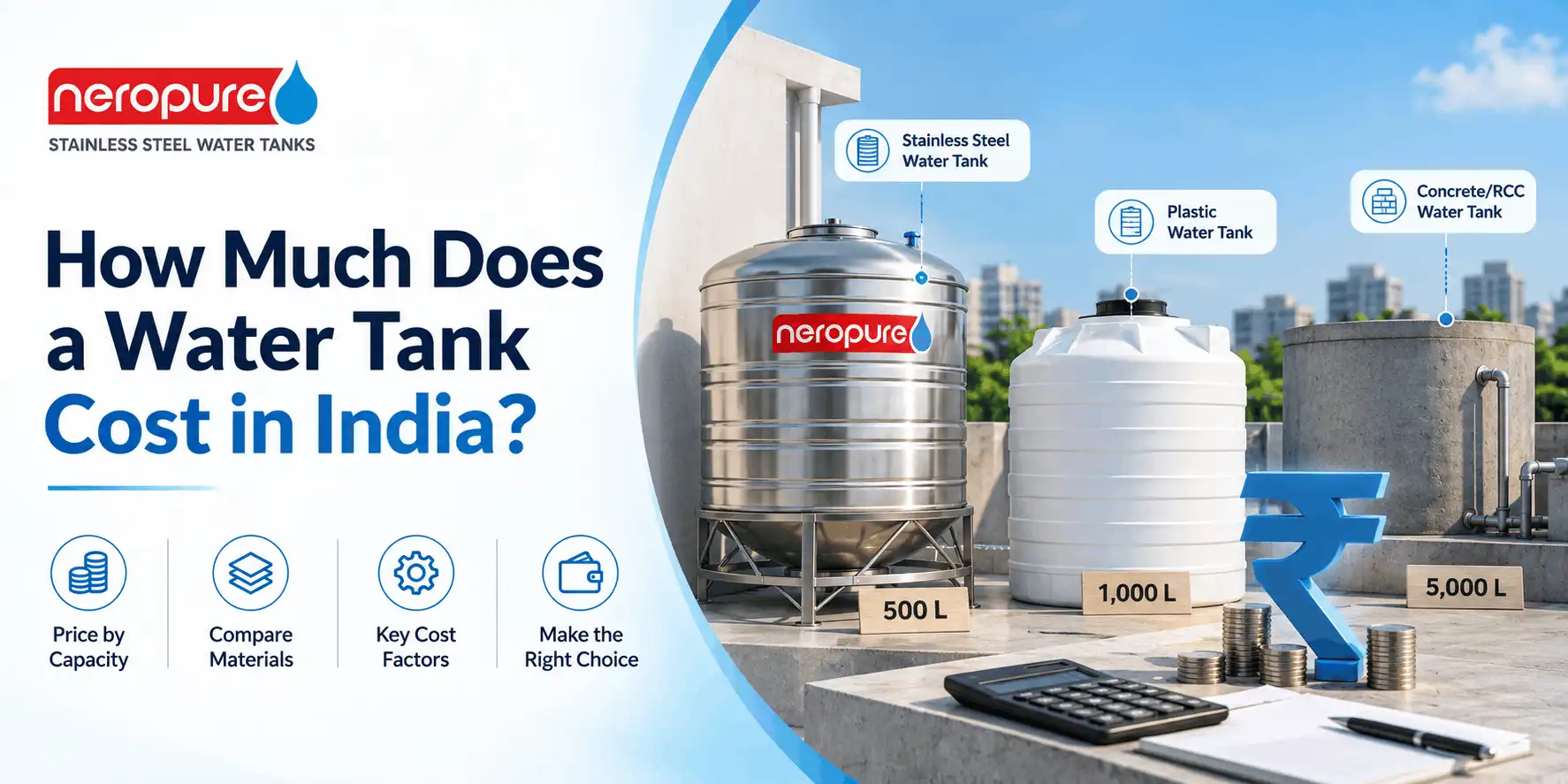
If you are planning to buy a water storage tank, one of your first questions is likely to be: how much does a water tank cost in India? The answer depends on more than the tank's capacity. Material, construction, insulation, fittings, installation requirements and the intended application can all influence the final amount.
A basic plastic water tank generally costs much less upfront than a premium stainless steel water tank. Similarly, purchasing an overhead tank is a different expense from constructing an underground water storage system, where excavation, civil work and waterproofing may add substantially to the budget.
For a useful comparison, consider the tank's purchase price separately from its installation cost and ongoing requirements.
For example, Neropure's existing stainless steel pricing guide gives indicative references of approximately ₹40,000–₹45,000 for a 500-litre tank and ₹95,000–₹1 lakh for a 2,000-litre tank. These are rough estimates, not guaranteed current quotations, and the actual price depends on the selected specifications and project requirements.
This guide explains how much water storage tanks can cost, what affects their prices, and how to choose an option that suits your water storage needs and budget.
What Is the Average Cost of a Water Tank in India?
There is no single price that applies to every water tank. A small household tank, a large-capacity commercial tank and an insulated stainless steel tank differ in materials, manufacturing requirements and intended use.
As a general budgeting reference, smaller plastic tanks may cost a few thousand rupees, depending on capacity and construction. Premium multilayer plastic tanks can cost more than basic models of the same capacity. Stainless steel tanks typically require a larger initial investment, while large underground systems may involve additional civil construction expenses.
The following table provides a starting point for understanding the different cost categories.
| Water tank type | Main factors affecting cost |
|---|---|
| Basic plastic water tank | Capacity, material, wall construction and fittings |
| Multilayer plastic water tank | Capacity, layer configuration and insulation features |
| Stainless steel water tank | Capacity, steel grade, construction, insulation and fittings |
| Large-capacity storage tank | Engineering, structural requirements, transport and installation |
| Underground water storage system | Tank or construction material, excavation, waterproofing and civil work |
These categories should not be treated as directly interchangeable. A lower-priced tank may meet a straightforward storage requirement, while a more specialised tank may be designed for different environmental or operational conditions.
To estimate your budget accurately, start by identifying the capacity you need and the material that suits your application.
How Much Does a Water Tank Cost by Capacity?
Capacity is one of the first factors buyers consider when comparing prices. However, two tanks with the same storage capacity can have significantly different prices because their materials and construction may differ.
How Much Does a 500-Litre Water Tank Cost?
A 500-litre tank may suit a small household, a limited storage requirement or a secondary water supply, depending on daily consumption and the reliability of the incoming supply.
For a basic plastic tank, publicly available Indian retail listings and price guides indicate that prices can fall within a range of a few thousand rupees. The exact amount varies according to the number of layers, construction and seller.
A stainless steel tank is a different investment. Neropure's existing pricing guide uses approximately ₹40,000–₹45,000 as an indicative reference for a 500-litre stainless steel tank. The final quotation may differ according to grade, insulation, construction, fittings, transportation and installation.
When comparing prices, make sure you are comparing tanks made for similar purposes rather than comparing the capacity alone.
How Much Does a 1,000-Litre Water Tank Cost?
A 1,000-litre tank is a common capacity to consider for household and smaller commercial water storage. Whether it is sufficient depends on the number of occupants, daily consumption, water availability and the amount of reserve storage required.
The price of a 1,000-litre tank varies considerably by material. A basic plastic tank and a stainless steel tank with specialised construction can have very different price points.
For a meaningful comparison, check the tank's construction, material specification, fittings, insulation requirements and warranty terms. Also confirm whether delivery and installation are included in the quotation.
It is better to request a specification-based price than to assume that every 1,000-litre tank should fall within the same budget.
How Much Does a 2,000-Litre Water Tank Cost?
A 2,000-litre tank may be suitable for a larger home, a small commercial property or another application requiring more storage capacity. The right choice depends on demand, available space and the installation arrangement.
For stainless steel water storage, Neropure's existing pricing guide gives approximately ₹95,000–₹1 lakh as a rough reference for a 2,000-litre tank. This figure should not be treated as a fixed market price or a guaranteed quotation. The grade, insulation, construction, fittings, customisation and installation requirements can change the final amount.
Because the difference between specifications can be substantial, buyers should compare the complete tank configuration rather than selecting an option solely by its litre capacity.
For a more detailed breakdown, read the stainless steel water tank price in India guide.
How Much Does a 5,000-Litre Water Tank Cost?
A 5,000-litre tank may be considered for larger homes, commercial premises, hospitality facilities, institutions or other sites with higher water storage requirements.
At this capacity, material selection and installation planning become particularly important. The tank may require suitable access for delivery, a properly designed base, adequate clearance and an assessment of the load imposed by the stored water.
The price also depends on whether the tank is plastic, stainless steel or another construction type. Insulation, structural design, fittings and project-specific requirements can further affect the quotation.
For a larger tank, ask the supplier to provide a written specification and identify any excluded installation or transport costs before comparing offers.
How Much Does a 10,000-Litre Water Tank Cost?
A 10,000-litre tank may serve apartment buildings, hotels, industrial premises, institutions and other applications where substantial water storage is needed.
The cost depends on the design and construction method. A prefabricated storage tank, a large modular system and an underground reinforced-concrete tank are different solutions with different cost structures.
For underground systems, the total project budget may include excavation, reinforcement, concrete, waterproofing, plumbing and labour. For an above-ground tank, delivery, lifting equipment, the foundation or support structure and plumbing connections may be relevant expenses.
At this scale, a project-specific quotation is generally more useful than relying on a generic online price estimate.
How Much Do Water Storage Tanks Cost by Material?
Material is one of the biggest reasons water tank prices vary. Each option has different upfront costs, construction characteristics and suitability for particular applications.
Plastic Water Tank Cost
Plastic tanks are widely considered for residential water storage because they are lightweight and often relatively affordable to purchase and install.
The price depends on capacity, material, wall construction, number of layers and additional features. A basic tank may cost considerably less than a multilayer model designed with specific protective or thermal features.
Plastic can be a practical option when the main priorities are initial affordability, easy handling and straightforward installation. However, buyers should still assess the product's intended use, construction quality, installation requirements and maintenance instructions.
The lowest advertised price is not necessarily the best comparison if the products differ in capacity, material specification or included fittings.
Stainless Steel Water Tank Cost
Stainless steel tanks generally require a higher initial investment than basic plastic tanks. Their price can vary according to the steel grade, capacity, shell construction, fabrication, insulation, fittings and customisation.
For example, Neropure's indicative pricing references place a 500-litre stainless steel tank at approximately ₹40,000–₹45,000 and a 2,000-litre tank at approximately ₹95,000–₹1 lakh. These figures are intended as rough references and should be reconfirmed before purchase.
The value of stainless steel depends on the requirements of the application. Buyers may prioritise its construction, cleanability, appearance or available insulation configurations. The right specification should be selected according to the water conditions, installation environment and intended use.
If you are considering stainless steel, the detailed guide to stainless steel water tank prices in India explains the main cost factors.
Concrete or RCC Water Tank Cost
Reinforced cement concrete (RCC) tanks are often constructed as part of a building or underground water storage system.
Unlike a ready-made tank with a straightforward purchase price, an RCC tank's cost can include excavation, site preparation, reinforcement steel, concrete, shuttering, labour, waterproofing and finishing.
The total amount depends on the dimensions, depth, soil conditions, design, local labour rates and construction requirements. An underground tank constructed in difficult ground conditions may cost substantially more than one built on a straightforward site.
When comparing an RCC system with a prefabricated tank, compare the complete installed solution rather than just the material cost.
Underground Water Tank Cost
The cost of an underground water tank depends on whether you are purchasing a prefabricated tank or constructing a storage chamber on site.
A prefabricated tank may require excavation, bedding or base preparation, suitable connections and backfilling according to the manufacturer's instructions. An RCC tank requires a different construction process, which may include structural design, reinforcement, concrete work and waterproofing.
Soil conditions, groundwater, excavation depth, site access and local construction rates can all influence the final cost.
If you are planning an underground installation, obtain a quotation that separates the tank or construction cost from excavation, plumbing, waterproofing and other civil work. This makes it easier to understand where the budget is going.
What Factors Affect the Price of a Water Tank?
Capacity and material provide a starting point, but several other factors can influence the price you pay.
Tank Capacity and Dimensions
A larger tank generally requires more material and may involve different manufacturing or structural requirements. However, the price does not necessarily increase in direct proportion to capacity.
The shape, dimensions, wall construction, manufacturing process and installation arrangement can all affect the final cost. Large tanks may also require additional planning for transportation, lifting and structural support.
Choose a capacity that reflects your actual storage requirement instead of automatically buying the largest tank within your budget.
Material Grade and Construction Quality
For stainless steel tanks, the grade is an important specification. SS 304 and SS 316 have different alloy compositions and corrosion-resistance characteristics, so the appropriate grade depends on the water chemistry and installation environment.
Construction quality also matters. Fabrication, welding, joints, surface finishing and the design of fittings can affect the suitability of the finished tank.
For a detailed comparison, read SS 304 vs SS 316 water tank.
Number of Layers and Insulation
Some tanks use multilayer construction or insulation to address particular storage requirements. These features can increase the initial cost because they involve additional materials and manufacturing processes.
However, the number of layers alone does not establish whether a tank is better. Buyers should understand the purpose of each layer, the type of insulation used and the conditions for which the construction is intended.
An insulated water tank may be worth considering when reducing heat transfer is an important requirement. Its value depends on the design, installation and intended use; insulation should not be treated as a guarantee that water will remain at a particular temperature.
Fittings and Customisation
Inlet, outlet, overflow and drain connections can affect the final specification. Depending on the application, buyers may also need particular dimensions, connection positions or other custom features.
A quotation should clarify which fittings are included and whether additional plumbing components are required. Otherwise, an apparently cheaper offer may exclude items needed to complete the installation.
Manufacturer Support and Warranty
The manufacturer's documentation, warranty terms, installation guidance and after-sales support are also relevant to the purchase decision.
Check what the warranty covers, any exclusions, the recommended maintenance procedures and whether installation must follow particular requirements. Compare these details alongside the quoted price rather than assuming that all tanks provide the same level of support.
How Much Does It Cost to Install a Water Tank?
The purchase price is only one part of the total budget. Installation costs depend on the type of tank, its location and the work required to connect it to the water supply.
For an overhead tank, possible expenses include transportation, lifting, a suitable base or support structure, plumbing connections, valves and installation labour.
For an underground tank, the work may be more extensive. Excavation, ground preparation, structural construction where required, waterproofing, backfilling and plumbing can all contribute to the final project cost.
Not every installation needs all these services. A replacement tank in an accessible location may require relatively limited work, while a new installation on a difficult site may require additional equipment and labour.
Before approving a quotation, clarify whether the price includes delivery, lifting, fittings, plumbing, the base or support structure and commissioning. Also check whether taxes and any site-specific expenses are included.
If you need to understand the installation requirements for Neropure's solutions, visit the water tank installation page.
Are Water Tanks Very Expensive?
Not necessarily. The cost depends on what you need the tank to do.
A basic plastic tank may be a relatively affordable choice for straightforward household storage. A premium multilayer tank or a stainless steel tank with specialised construction and insulation requires a larger initial budget. An underground storage system may also involve significant construction costs beyond the tank itself.
The important question is whether the selected tank meets your requirements at an appropriate overall cost.
For example, paying more for a particular material or insulation system makes sense only when its characteristics are relevant to the intended application. Similarly, choosing a cheaper tank without checking its suitability can create problems if it does not meet the storage, installation or environmental requirements.
Consider the purchase price alongside the specification, installation expenses, maintenance needs and expected operating conditions. Avoid assuming that the most expensive tank is automatically the best choice or that the cheapest option will always provide the lowest long-term cost.
How Do You Choose a Water Tank Within Your Budget?
Start by estimating how much water you need to store. Consider the number of users, daily consumption, reliability of the water supply and the reserve capacity required for your situation.
Next, identify the installation location. An overhead tank may require a suitable supporting structure and access for lifting, while an underground system may need excavation and civil work. Available space and site conditions can narrow your options before you compare prices.
Then choose the material and construction according to the intended use. A basic plastic tank may suit a straightforward storage requirement, while stainless steel may be worth considering where its material and construction characteristics align with the project's needs.
Finally, request comparable quotations. Each quotation should specify the capacity, material, construction, included fittings, delivery arrangements, installation scope and warranty terms.
If you are considering stainless steel, the guide on how to choose the right stainless steel water tank explains the main selection factors.
Is a Stainless Steel Water Tank Worth the Higher Cost?
A stainless steel water tank can be worth considering when its construction and material properties suit the application. However, it is not the automatic choice for every buyer.
Plastic tanks can be attractive when initial affordability and lightweight construction are priorities. Stainless steel tanks may be preferred when buyers value their construction, cleanability, appearance or particular insulation configurations.
The comparison should account for the intended use, water conditions, installation environment, maintenance requirements and overall specification. It should also distinguish between the initial purchase price and the potential value of the tank over its period of use.
A higher initial price alone does not prove that a tank will deliver a better financial outcome. That depends on the product, its operating conditions and how well it meets the buyer's needs.
For a balanced material comparison, read stainless steel vs plastic water tank.
How to Get an Accurate Water Tank Price
The easiest way to avoid confusion is to request a quotation based on your actual requirements rather than asking for a price by capacity alone.
Provide the supplier with the required storage capacity, intended application, preferred material if known, installation location and any specific requirements for insulation, dimensions or fittings. If the tank will be used in a commercial or institutional setting, explain the project's storage needs and site constraints.
Ask for the quoted specification in writing and confirm whether delivery, installation, plumbing, the supporting structure and applicable taxes are included. If the supplier recommends a particular material grade or construction, ask how it relates to your application.
This approach makes it easier to compare quotations fairly and reduces the risk of overlooking expenses that arise after the initial purchase.
Why Consider Neropure for Water Storage?
Choosing a water tank involves more than comparing prices. Capacity, construction, insulation, installation requirements and the intended application all influence which solution makes sense.
Neropure offers stainless steel water-storage solutions across different capacities and configurations for a range of storage requirements. Depending on the selected configuration, buyers can evaluate construction and insulation options alongside the capacity and intended use.
Whether you are planning water storage for a home, commercial building or institutional application, the right starting point is a clear understanding of the required capacity and project conditions.
For a more specific price assessment, share your requirements with Neropure and request a quotation based on the appropriate tank specification.
Enquire Now to discuss your water storage requirements with Neropure.
Final Thoughts
So, how much does a water tank cost in India? The answer depends on its capacity, material, construction, insulation, fittings and installation requirements.
A basic plastic tank may cost a few thousand rupees, while a premium stainless steel tank can require a substantially higher initial investment. Large-capacity and underground systems may also involve additional structural, transportation or civil construction expenses.
Rather than relying on one price figure, compare tanks with similar specifications and calculate the complete cost of getting the system installed and ready for use.
For buyers considering stainless steel, Neropure's dedicated pricing guide provides indicative capacity references and explains the factors that influence the final quotation.
The best purchasing decision is not necessarily the cheapest or most expensive tank. It is the one whose capacity, construction and material are appropriate for your water storage needs and budget.
Frequently Asked Questions
How much does a water tank cost in India?
Water tank prices vary by capacity, material, construction and installation requirements. Basic plastic tanks may cost a few thousand rupees, while premium stainless steel tanks can cost considerably more. Underground systems may also require excavation, waterproofing and civil work.
How much does a 1,000-litre water tank cost?
The price of a 1,000-litre tank depends on whether it is plastic, stainless steel or another construction type. The number of layers, insulation, fittings, delivery and installation can also affect the final amount. Request a specification-based quotation for an accurate price.
How much does a 2,000-litre water tank cost?
A 2,000-litre tank can vary considerably in price according to its material and construction. Neropure's existing stainless steel pricing guide gives approximately ₹95,000–₹1 lakh as an indicative reference for a 2,000-litre stainless steel tank. This is not a guaranteed current price, and the actual quotation depends on the specification and project requirements.
How much does it cost to install a water tank?
Installation costs depend on the location, accessibility, plumbing, lifting requirements and support structure. Underground systems may additionally require excavation, waterproofing and civil construction. Ask for an itemised quotation to understand the complete cost.
Are stainless steel water tanks more expensive than plastic tanks?
Generally, yes. Stainless steel tanks typically have a higher initial purchase price than basic plastic tanks. Whether the additional investment is appropriate depends on the application, required construction, water conditions and the buyer's priorities.
What is the price of a 500-litre stainless steel water tank?
Neropure's existing pricing guide gives approximately ₹40,000–₹45,000 as a rough reference for a 500-litre stainless steel tank. Actual quotations can vary according to grade, construction, insulation, fittings, delivery and installation.
Does the number of layers affect water tank cost?
It can. Additional layers or insulation materials may increase manufacturing costs. However, layer count alone does not establish product quality, so buyers should examine the actual construction and purpose of each layer.
How much does an underground water tank cost?
The cost depends on the storage capacity, construction method, excavation depth, soil conditions, waterproofing, labour and plumbing. A prefabricated tank and an RCC tank constructed on site have different cost structures, so they should be compared on a complete-project basis.
Why do water tank prices vary between manufacturers?
Prices can differ because of material specifications, manufacturing processes, construction, fittings, insulation, warranty terms, delivery arrangements and installation support. Comparing written specifications is more useful than comparing price alone.
Is an expensive water tank worth buying?
It can be, if the tank's material and construction provide features that are relevant to your requirements. However, a higher price does not automatically mean better value. Consider capacity, application, construction, installation and maintenance needs before deciding.
About the author
Neropure Editorial Team
The Neropure Editorial Team writes buying guides and technical explainers on water storage with input from the engineers, production staff and installation crews at our stainless steel tank manufacturing unit in Binola, Gurugram. Every article is reviewed for technical accuracy before it is published and updated when standards, materials or prices change.
Published · Last reviewed
Plan your water storage budget with Neropure
Share your capacity, installation location and requirements to request a specification-based quotation.
Enquire Now