
SS 304 vs SS 316 Water Tank: What's the Difference?
SS 304 and SS 316 are both widely used stainless-steel grades, but they perform differently in demanding environments. Learn which grade makes sense for your water tank.
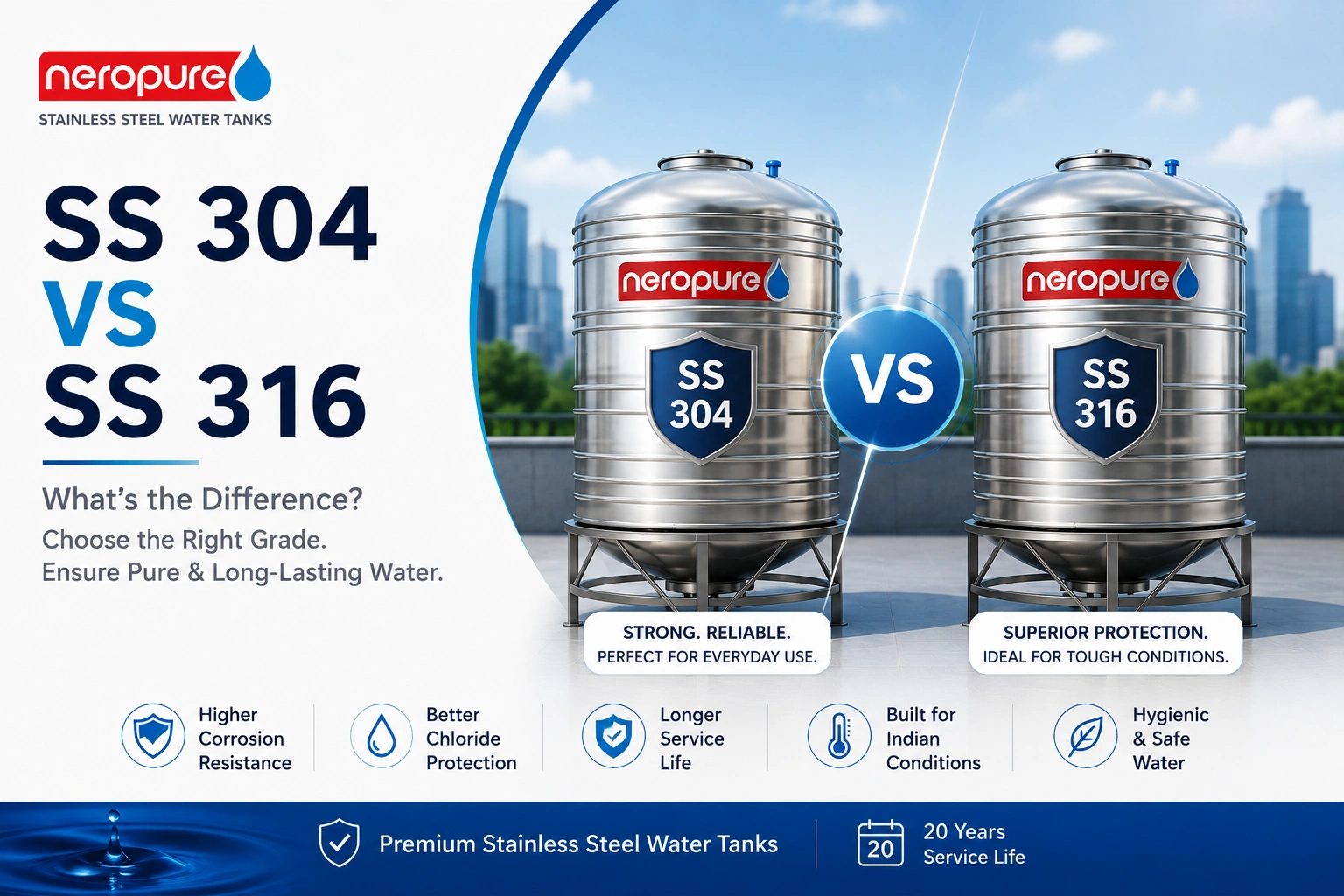
When choosing a stainless steel water tank, one of the most important decisions is the grade of stainless steel used in its construction. SS 304 and SS 316 are two of the most commonly discussed grades, and both can be suitable for water storage. However, they are not identical.
The key difference lies in their chemical composition. SS 316 contains molybdenum, which gives it greater resistance to certain forms of corrosion, particularly in chloride-rich environments. SS 304, meanwhile, is a widely used general-purpose stainless steel that offers good corrosion resistance for many standard applications.
So, is SS 316 automatically the better choice for a water tank? Not necessarily.
The right choice depends on several factors, including the water chemistry, chloride exposure, surrounding environment, application, fabrication quality and overall tank design. Understanding these differences can help you choose a stainless steel water tank that is appropriate for your actual requirements rather than simply choosing the more expensive grade.
At a glanceWhat Is the Difference Between SS 304 and SS 316?
SS 304 and SS 316 are both austenitic stainless steel grades. They contain chromium and nickel, which contribute to their corrosion resistance and other material properties. The major compositional distinction is that SS 316 also contains molybdenum.
Typical compositions show SS 304 containing approximately 17.5–19.5% chromium and 8–10.5% nickel, while SS 316 contains approximately 16.5–18.5% chromium, 10–13% nickel and 2–2.5% molybdenum. Exact compositions depend on the applicable standard and product specification.
That additional molybdenum is important because it improves resistance to localized corrosion, especially pitting and crevice corrosion associated with chloride exposure.
In practical terms, SS 304 is a strong general-purpose option, while SS 316 is generally considered when the tank or its environment presents greater corrosion challenges.
| Factor | SS 304 | SS 316 |
|---|---|---|
| Stainless steel type | Austenitic | Austenitic |
| Chromium | High | High |
| Nickel | Present | Present, generally higher range |
| Molybdenum | No intentional addition | Typically around 2–2.5% |
| General corrosion resistance | Very good | Higher in many aggressive environments |
| Chloride resistance | Lower than SS 316 | Better than SS 304 |
| Typical positioning | General-purpose applications | More demanding environments |
| Relative material cost | Generally lower | Generally higher |
SS 304
Austenitic
SS 316
Austenitic
SS 304
High
SS 316
High
SS 304
Present
SS 316
Present, generally higher range
SS 304
No intentional addition
SS 316
Typically around 2–2.5%
SS 304
Very good
SS 316
Higher in many aggressive environments
SS 304
Lower than SS 316
SS 316
Better than SS 304
SS 304
General-purpose applications
SS 316
More demanding environments
SS 304
Generally lower
SS 316
Generally higher
The important point is that grade selection should follow the application, not the assumption that a higher-numbered grade is always necessary.
Material performanceWhy Does Stainless Steel Grade Matter in a Water Tank?
A water tank is continuously exposed to its stored water and surrounding environment. The material therefore needs to tolerate the conditions it will encounter over its operating life.
Stainless steel protects itself through a very thin passive surface layer that helps resist corrosion. However, stainless steel is not completely immune to corrosion. The performance of a particular grade depends on the environment in which it is used.
For water-storage applications, factors such as chloride concentration, temperature, oxygen levels, design, fabrication and surface condition can influence corrosion behaviour. The British Stainless Steel Association notes that 304 and 316 types are generally suitable for cold or unheated drinking-water storage when tanks are properly designed, fabricated and finished.
General-purpose gradeSS 304 Water Tank: When Is It a Good Choice?
SS 304 is one of the most widely used austenitic stainless steel grades because it combines good corrosion resistance with versatility and comparatively broad application suitability.
For many standard water-storage requirements, SS 304 can be an appropriate choice when the stored water and surrounding environment do not create unusually aggressive corrosion conditions.
SS 304 for Homes and Standard Water Storage
For a typical residential water-storage application using clean, cold water, SS 304 can be a practical grade to consider. It is also widely used across food, kitchen, architectural and other applications where corrosion resistance and cleanability are important.
However, “suitable for many homes” should not be interpreted as “suitable for every home.”
Water chemistry can vary considerably depending on the source. Municipal water, borewell water and treated water may present different conditions.
The correct specification should therefore consider the actual water quality and environmental exposure rather than selecting a grade based solely on the fact that the tank is residential.
SS 304 for Commercial Buildings
SS 304 can also be considered for offices, apartment buildings, commercial properties and other general-purpose water-storage applications where the environmental and water conditions are relatively moderate.
For these applications, buyers should evaluate the complete tank specification, including capacity, construction, fittings, fabrication quality and installation requirements, rather than treating the steel grade as the only performance indicator.
Demanding environmentsSS 316 Water Tank: When Does It Make More Sense?
The main reason buyers consider SS 316 is its improved resistance to corrosion in more demanding environments.
The addition of molybdenum improves SS 316's resistance to localized corrosion, particularly where chlorides are involved. This is one reason 316 is commonly used in applications involving more aggressive environments, including certain coastal, chemical, food-processing and marine-related applications.
That does not mean every stainless steel water tank should be made from SS 316. It means that SS 316 becomes more relevant as corrosion exposure increases.
Coastal and Salt-Laden Environments
Coastal locations deserve particular attention because salt and chloride exposure can increase corrosion risk.
Where a tank is exposed to a chloride-rich environment, SS 316 may provide an advantage over SS 304 because of its greater resistance to chloride-related localized corrosion.
However, the decision should not be reduced to a simple rule such as “coastal area equals SS 316.” Actual exposure, water chemistry, tank location, ventilation, surface contamination, construction and maintenance can all influence performance.
Higher-Chloride Water
Chloride is particularly important when comparing 304 and 316.
Chloride ions can contribute to localized corrosion mechanisms such as pitting and crevice corrosion. SS 316's molybdenum content improves its resistance to these mechanisms compared with SS 304.
Technical detailSS 304 vs SS 316: Corrosion Resistance Explained
Corrosion resistance is the most important technical distinction between SS 304 and SS 316 for many tank-selection decisions.
SS 304 offers strong general corrosion resistance and is widely used where the environment is not excessively aggressive. SS 316 adds molybdenum to the alloy, improving resistance to certain localized corrosion mechanisms and making it better suited to many chloride-exposed conditions.
What Is Pitting Corrosion?
Pitting is a form of localized corrosion in which small areas of the metal surface become damaged while much of the surrounding surface may remain intact.
Chloride ions are one of the important factors associated with pitting of stainless steels. This is why chloride exposure is particularly relevant when deciding between 304 and 316.
What Is Crevice Corrosion?
Crevice corrosion can occur in confined areas where conditions differ from the surrounding surface. Gaps, joints and other poorly designed or difficult-to-clean areas can become potential corrosion sites.
This is an important reminder that good material selection must be combined with good tank design and fabrication.
The British Stainless Steel Association specifically recommends designs with as few engineering crevices as possible and notes the importance of appropriate fabrication and fully filled welded joints in relevant water-tank applications.
Is SS 316 Corrosion-Proof?
No.
This is one of the most important points to understand before buying a stainless steel water tank.
SS 316 has greater corrosion resistance than SS 304 in many aggressive environments, but it is not immune to corrosion. Particularly severe chloride exposure and unsuitable conditions can still create corrosion risks.
Therefore, choosing SS 316 should not replace proper engineering, fabrication, installation and maintenance.
Material designationWhat Does the “L” Mean in SS 304L and SS 316L?
When researching stainless steel water tanks, you may also encounter terms such as SS 304L and SS 316L.
The “L” stands for low carbon.
The lower carbon content is particularly relevant to welded stainless steel because it can help reduce the risk of sensitisation and associated corrosion problems in certain fabrication conditions.
For example, commonly specified compositions place the maximum carbon level at around 0.08% for standard 304 and 316, compared with around 0.030% for their corresponding 304L and 316L grades.
The important takeaway is that 304L is not simply a “stronger 304,” and 316L is not simply a “better 316.” The L designation relates primarily to carbon content and has particular importance in welded construction.
When a tank is fabricated using extensive welding, the exact material designation and fabrication procedure should be confirmed with the manufacturer.
Water chemistryDoes TDS Affect the Choice Between SS 304 and SS 316?
TDS, or Total Dissolved Solids, is often mentioned when Indian buyers compare water tanks.
However, TDS alone should not determine whether you choose SS 304 or SS 316.
TDS indicates the total concentration of dissolved substances in water, but it does not tell you exactly which substances are present or how they may affect stainless steel.
For stainless-steel grade selection, chloride concentration and the broader water chemistry are particularly relevant. Temperature, oxygen conditions and the physical environment can also influence corrosion behaviour.
If your water comes from a borewell, has unusual chemistry, contains elevated chlorides or requires treatment chemicals, it is better to assess the available water-quality information and discuss the appropriate grade with the tank manufacturer or technical consultant.
Local contextIs SS 316 Better Than SS 304 for Indian Conditions?
There is no single stainless steel grade that is automatically best for every location in India.
India has widely varying climatic and water conditions. A tank installed in an inland residential property may face very different conditions from one installed in a coastal environment or industrial facility.
- For standard cold-water storage under relatively moderate conditions, SS 304 can be an appropriate choice.
- For higher chloride exposure, saline conditions or more demanding environments, SS 316 may provide a useful additional margin of corrosion resistance.
- For industrial or technically complex applications, the decision should be based on the actual water chemistry, operating conditions and project requirements.
The British Stainless Steel Association confirms that both 304 and 316 types can generally be suitable for cold or unheated drinking-water storage when the tank is properly designed, fabricated and finished.
Therefore, the right question is not simply:
“Is SS 316 better than SS 304?”
It is:
“Which grade provides the appropriate corrosion resistance for my water, environment and application?”
PriceSS 304 vs SS 316 Water Tank: Which Is More Expensive?
SS 316 is generally more expensive than SS 304 because its alloy composition includes additional elements, particularly molybdenum, which contributes to its enhanced corrosion resistance and material cost.
But the initial material cost should not be the only consideration.
Choosing SS 316 when the application genuinely requires its additional corrosion resistance can make sense. On the other hand, specifying SS 316 for a standard application where SS 304 is technically appropriate may add cost without providing a meaningful benefit.
This is why stainless steel water tank pricing should always be evaluated alongside the specification.
For a broader understanding of capacity, grade, insulation, construction, fittings, installation and other factors that influence tank pricing, buyers should also consider the Stainless Steel Water Tank Price in India guide.
Decision guideSS 304 vs SS 316: Which One Should You Choose?
The simplest way to approach the decision is to start with your application rather than the price or the grade name.
SS 304 can be considered when the tank is intended for general-purpose water storage and the water chemistry and surrounding environment do not present unusually aggressive corrosion conditions.
SS 316 can be considered when the tank faces greater chloride exposure, saline conditions or other environmental factors where its additional corrosion resistance may provide a meaningful advantage.
Technical evaluation is advisable when the water chemistry is unusual, the application is industrial, the tank is exposed to aggressive chemicals or the operating conditions are demanding.
You can also read: How to Choose the Right Stainless Steel Water Tank?
Full specificationWhat Else Should You Check Besides the Stainless Steel Grade?
A common purchasing mistake is to compare tanks solely by whether they use SS 304 or SS 316.
The steel grade is important, but it is only one part of the specification.
Tank Construction
Look at how the tank is constructed rather than focusing only on the material designation.
Depending on the product, construction may involve different layers, shells, insulation arrangements and structural features.
If you are considering an insulated stainless steel water tank, understand what the insulation system is designed to achieve and how it forms part of the overall tank construction.
Welding and Fabrication
Fabrication quality matters because welding, joints and surface condition can influence stainless-steel performance.
A well-selected grade can still perform poorly if fabrication is inadequate. Appropriate welding practices, finishing and design are therefore important parts of a quality water-storage solution.
Fittings and Connections
The inlet, outlet, overflow and drain arrangements should suit the intended installation.
Connections also deserve attention because interactions between different metals can create galvanic-corrosion considerations under certain conditions. Proper material compatibility and design should therefore be considered when specifying the tank and its fittings.
Installation Environment
A rooftop tank, indoor tank, coastal installation and industrial installation can each face different environmental conditions.
The installation location should therefore be considered alongside the water chemistry and tank grade.
Capacity and Dimensions
A technically appropriate grade does not help if the tank does not provide sufficient storage capacity or cannot be properly accommodated at the installation site.
Capacity, footprint, height, access, maintenance clearance and structural requirements should all be assessed before finalising the tank.
By use caseSS 304 vs SS 316 for Different Applications
The most appropriate grade can vary depending on where and how the tank will be used.
Homes
For general residential drinking-water storage under moderate conditions, SS 304 may be an appropriate option. The water source and local environment should still be considered.
Apartments and Commercial Buildings
Larger residential and commercial projects require greater attention to capacity, installation, plumbing configuration and structural requirements in addition to material grade.
Hotels and Hospitals
These applications place particular importance on hygiene, cleanability, fabrication quality and reliable water storage. Grade selection should be considered alongside the complete tank specification.
Industrial Facilities
Industrial applications require a more application-specific approach because water chemistry, treatment processes and surrounding chemicals can vary significantly.
Coastal Locations
Where chloride exposure is materially higher, SS 316 can become a more attractive choice because of its improved resistance to chloride-related corrosion.
Buyer pitfallsCommon Mistakes When Choosing Between SS 304 and SS 316
One of the biggest mistakes is assuming that SS 316 is always better simply because it costs more.
A more corrosion-resistant grade can be valuable when the environment requires it, but unnecessary specification can increase the project cost without delivering a corresponding benefit.
Another mistake is selecting SS 304 solely because it is less expensive without considering the water and environmental conditions. The correct grade should be appropriate for the actual application.
Buyers also sometimes use TDS as the only indicator of whether SS 316 is necessary. TDS can be useful water-quality information, but it does not provide the complete chemistry required for stainless-steel grade selection.
Finally, it is a mistake to overlook fabrication and tank design. Material grade, construction quality, welding, surface finish, fittings and installation all contribute to the performance of a stainless steel water tank.
Before you buyA Practical SS 304 vs SS 316 Selection Checklist
Before finalising your tank, consider the water source and chemistry, chloride exposure, installation environment, required capacity, tank construction, fittings, fabrication quality, insulation requirements and manufacturer support.
NeropureWhy Consider Neropure for Stainless Steel Water Storage?
Choosing the right stainless steel water tank is about matching the tank to the application rather than selecting a grade in isolation.
Neropure offers stainless steel water-storage solutions across different capacities and configurations, allowing the tank specification to be considered according to the intended application, storage requirement and construction needs.
Depending on the application, factors such as capacity, insulation, tank construction and installation requirements can all form part of the selection process.
If you are unsure whether your project should use SS 304, SS 316 or another appropriate configuration, discussing the application and water-storage requirements with the technical team can help you arrive at a more suitable specification.
Enquire Now to discuss your stainless steel water tank requirements with Neropure.
ConclusionFinal Thoughts
The difference between SS 304 and SS 316 is not simply that one is “better” than the other.
SS 304 is a widely used, versatile stainless steel grade that can be suitable for many standard water-storage applications. SS 316 contains molybdenum and generally offers greater resistance to chloride-related localized corrosion, making it particularly relevant for more demanding environments.
For most buyers, the selection process should follow a logical sequence: understand the water-storage requirement, determine the capacity, assess the water chemistry and environment, select the appropriate stainless steel grade, evaluate construction and fabrication, check installation requirements, and then compare the overall value of the available solutions.
Choose the grade that matches your water, environment and application—and make sure the complete tank is designed and fabricated to the same standard.
FAQFrequently Asked Questions
Is SS 304 or SS 316 better for a water tank?
Is SS 304 suitable for drinking-water storage?
Is SS 316 worth the extra cost?
Which is better for coastal areas, SS 304 or SS 316?
What is the difference between SS 304 and 304L?
What is the difference between SS 316 and 316L?
Does high TDS mean I need an SS 316 water tank?
Can SS 316 still corrode?
What should I check before buying an SS 304 or SS 316 water tank?
About the author
Neropure Editorial Team
The Neropure Editorial Team writes buying guides and technical explainers on water storage with input from the engineers, production staff and installation crews at our stainless steel tank manufacturing unit in Binola, Gurugram. Every article is reviewed for technical accuracy before it is published and updated when standards, materials or prices change.
Published · Last reviewed
Unsure whether your project should use SS 304, SS 316 or another configuration?
Enquire Now to discuss your stainless steel water tank requirements with Neropure.
Enquire Now