
Stainless Steel Water Tank Price in India: Cost Factors & Buying Guide
Planning to buy a stainless steel water tank? Understand indicative prices, capacity-wise costs and the key factors that determine the final tank price in India.
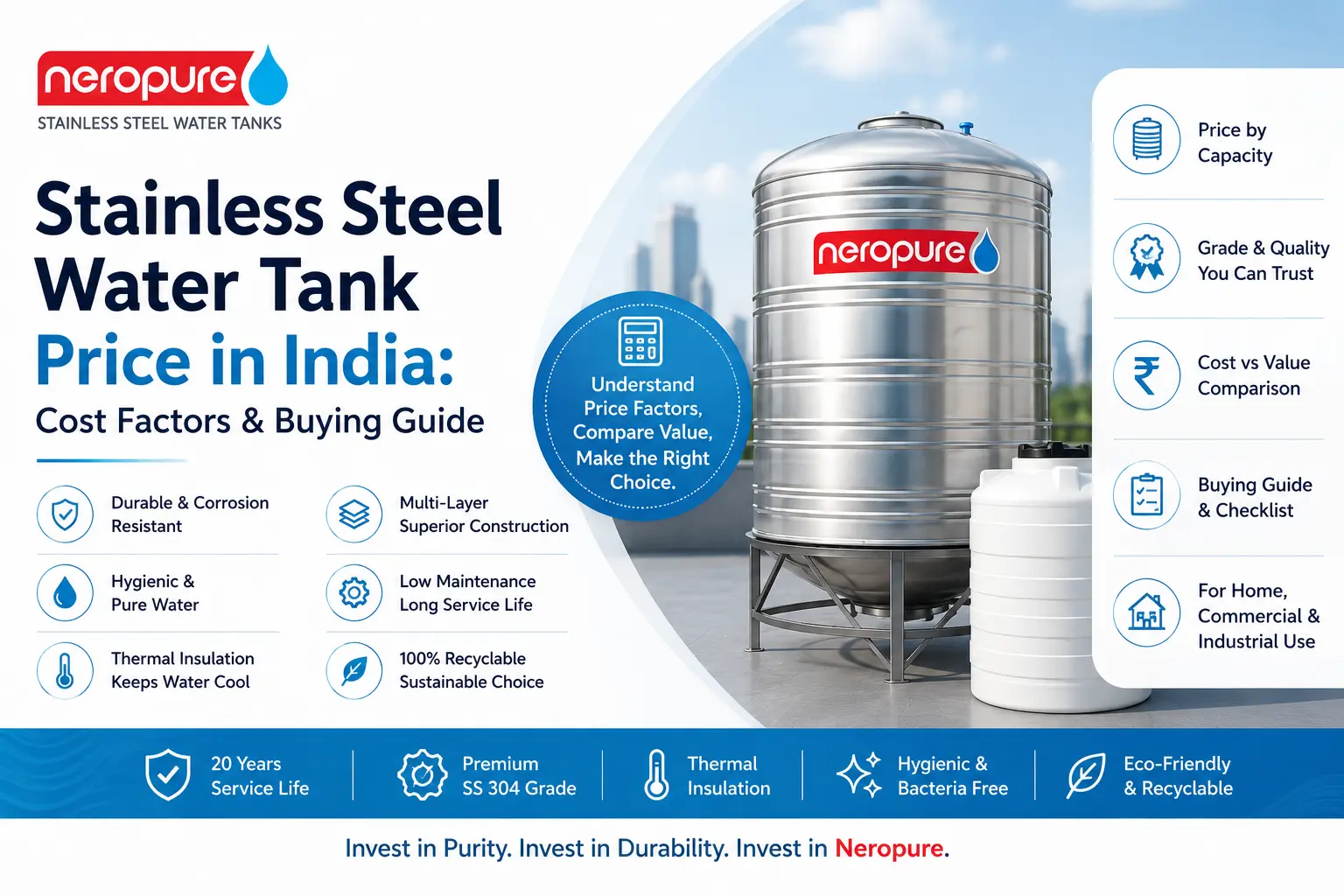
The price of a stainless steel water tank in India can vary significantly depending on its capacity, stainless steel grade, insulation, construction, fittings, design and installation requirements. A 500-litre tank and a 2,000-litre tank may serve similar basic purposes, but their construction and overall project requirements can be very different.
This is why looking for a single stainless steel water tank price in India can be misleading. For buyers, the better approach is to understand what actually determines the cost, what specifications deserve attention and how to compare quotations before making a purchase.
For a rough market reference, a 500-litre stainless steel water tank may fall around the ₹40,000–₹45,000 range, while a 2,000-litre tank may be approximately ₹95,000–₹1 lakh depending on the specification. These figures should be treated only as indicative estimates, not fixed prices, because the final quotation can change according to material grade, insulation, construction, accessories, transportation, installation and project requirements.
So, what should you consider before buying?
Cost factorsWhat Determines Stainless Steel Water Tank Price in India?
The most important thing to understand is that capacity is only one part of the price.
Two tanks with the same 2,000-litre capacity can have different prices because their construction, stainless steel grade, insulation system and fittings may not be identical.
A proper comparison should therefore look beyond the litre capacity.
Tank Capacity
Capacity is naturally one of the first factors affecting price.
A small residential tank requires considerably less material than a large commercial or institutional tank. As capacity increases, the amount of stainless steel, insulation material, structural components and associated fabrication can also increase.
Neropure's range extends across multiple capacities, from smaller tanks suitable for residential requirements to substantially larger storage solutions for commercial and institutional applications.
Among these capacities, 2,000-litre stainless steel water tanks can be a particularly practical size for buyers who need more substantial household, residential or commercial water storage without moving immediately into very large industrial capacities.
The correct capacity, however, should be determined by actual consumption, water-supply frequency, available space and required backup rather than simply choosing the largest tank available.
Stainless Steel Grade
The term “stainless steel” does not describe one single material.
Different stainless steel grades have different chemical compositions and performance characteristics. The grade selected for the inner water-contact surface can therefore influence both the tank's suitability and its cost.
This is especially important when water chemistry varies between locations.
Buyers should ask the manufacturer:
Which stainless steel grade is used for the inner shell?
They should also understand whether the outer shell uses the same or a different specification.
Insulation and Multilayer Construction
Insulation is another major factor that can influence the price of an insulated stainless steel water tank.
A basic tank construction and a multilayer insulated tank are not equivalent products.
Neropure's tank construction can incorporate multiple layers, including the stainless steel inner shell, heat-resistant basecoat, nitrile rubber layer, cross-linked PE foam, cellulose insulation wrap, twin-side laminated vacuum cushion and injected PU foam, depending on the configuration.
For rooftop installations exposed to Indian weather conditions, buyers should therefore compare the complete insulation specification instead of comparing only the external stainless steel shell.
Inner and Outer Shell Construction
A stainless steel water tank can have different shell configurations.
The inner shell is particularly important because it comes into contact with the stored water. The outer shell contributes to the tank's overall protection, appearance and construction.
A well-designed tank may therefore have a significantly different manufacturing cost from a basic single-shell product.
When comparing quotations, ask for the construction details of both the inner and outer shell. This is one of the easiest ways to identify whether two apparently similar quotations are actually offering comparable products.
Fittings and Connections
The final cost can also be influenced by the tank's inlet, outlet, overflow, drain and other connection requirements.
For a residential tank, the plumbing arrangement may be relatively straightforward.
For a larger building, hotel, hospital, factory, school or commercial facility, however, the tank may need to integrate into a more complex water-supply system.
In such cases, fittings and connection specifications should be considered part of the overall solution rather than an afterthought.
Customisation
Not every installation has identical space or plumbing requirements.
Some projects may require specific dimensions, connection positions, outlet arrangements, access provisions or other modifications.
Customisation can increase manufacturing complexity and therefore affect the final price.
This is particularly relevant for builders, architects, MEP consultants and contractors working with predefined architectural or services layouts.
Instead of asking only for the price of a tank, it is often better to provide the manufacturer with the project's actual requirements and request a specification-based quotation.
Indicative pricesStainless Steel Water Tank Price by Capacity
Capacity provides a useful starting point for understanding the price structure, although it should never be treated as a fixed price chart.
| Capacity | Indicative price perspective |
|---|---|
| 500 litres | Approximately ₹40,000–₹45,000 as a rough reference |
| 1,000 litres | Depends on grade, construction and insulation |
| 1,500 litres | Depends on specification and configuration |
| 2,000 litres | Approximately ₹95,000–₹1 lakh as a rough reference |
| 3,000 litres and above | Project-specific quotation becomes increasingly important |
| Large commercial capacities | Strongly dependent on engineering and configuration |
Indicative price perspective
Approximately ₹40,000–₹45,000 as a rough reference
Indicative price perspective
Depends on grade, construction and insulation
Indicative price perspective
Depends on specification and configuration
Indicative price perspective
Approximately ₹95,000–₹1 lakh as a rough reference
Indicative price perspective
Project-specific quotation becomes increasingly important
Indicative price perspective
Strongly dependent on engineering and configuration
For this reason, a manufacturer quotation should always state the specifications behind the quoted price.
Cost comparisonWhy Is a Stainless Steel Water Tank More Expensive Than a Plastic Tank?
One of the first questions buyers ask is simple:
“Why should I pay more for stainless steel?”
The answer is that you're not simply paying for the ability to store a particular number of litres. You're paying for the material, fabrication, structural construction, insulation where applicable, finishing, fittings and expected long-term performance of the complete tank system.
Plastic tanks have a strong advantage in terms of initial affordability and lightweight construction.
Stainless steel, on the other hand, can offer advantages in areas such as structural strength, durability, cleanability, premium construction and recyclability.
Therefore, the right comparison isn't necessarily:
₹X for plastic vs ₹Y for stainless steel.
It should be:
What am I receiving for the difference in investment, and how does that affect the tank's expected ownership over time?
This is particularly important when the tank is being installed as part of a new building or major renovation, where replacement can involve additional labour, access arrangements and plumbing modifications.
You may read this: Stainless Steel vs Plastic Water Tank: Which Is Better?
Capacity focusIs a 2,000-Litre Stainless Steel Water Tank Worth It?
For many buyers, 2,000 litres represents an interesting middle ground between smaller domestic storage and much larger commercial systems.
A 2,000-litre water tank stores approximately 2,000 litres of water, meaning the stored water itself has a mass of roughly two tonnes.
Before selecting a 2,000-litre tank, the buyer should consider the structural capacity of the installation location, tank dimensions, access for installation, plumbing arrangement and the actual water requirement.
A 2,000-litre capacity can be useful for larger homes, multi-family residential applications, offices, hospitality properties and other buildings where a smaller tank may not provide sufficient backup.
However, bigger is not automatically better.
An oversized tank can mean unnecessary investment and unused storage capacity, while an undersized tank can create water shortages during supply interruptions.
The right capacity is the one that balances daily consumption, supply availability and desired backup duration.
Buyer checklistWhat Should You Check Before Buying a Stainless Steel Water Tank?
Don't compare quotations based only on the final number.
Start by checking the capacity and confirm that the quoted tank actually provides the required usable storage.
Then check the stainless steel grade, particularly for the water-contact surface.
Next, understand the insulation construction. Ask whether the tank is insulated and what materials or layers are used.
You should also verify the inner and outer shell construction, connection sizes, inlet, outlet, overflow and drain provisions.
Installation requirements deserve equal attention. The manufacturer should be able to explain the required base, placement conditions and plumbing considerations.
Finally, ask about warranty, expected service life, maintenance requirements and after-sales support.
A professional quotation should make these details reasonably clear.
SizingHow to Calculate the Right Water Tank Capacity
The ideal tank capacity depends on how much water your building consumes and how reliable the incoming water supply is.
For a home, consider the number of residents and approximate daily consumption.
For apartments or residential developments, the calculation should account for the number of occupants and the building's water-supply system.
For hotels, hospitals, schools, factories and commercial buildings, consumption patterns can be considerably more complex.
A facility manager or MEP consultant should therefore consider factors such as:
For larger projects, capacity selection should be integrated into the overall water-supply design rather than decided independently.
ValueStainless Steel Water Tank vs Plastic Tank: Is the Higher Price Justified?
A stainless steel tank generally requires a higher initial investment than a conventional plastic tank.
That does not automatically make it the right choice for everyone.
If the primary objective is to minimise the initial purchase cost, a good-quality plastic tank can remain a practical solution.
But if the project prioritises long-term durability, structural strength, premium appearance, cleanability, engineered insulation and lifecycle considerations, stainless steel can justify a higher initial investment.
The decision becomes especially relevant when replacing a tank is difficult or disruptive.
For example, replacing a rooftop tank in a completed commercial building may involve access arrangements, labour, plumbing changes and operational disruption.
In such circumstances, the purchase decision should consider total ownership value, not simply the initial invoice.
SpecificationWhy Stainless Steel Tank Construction Matters More Than the Price Tag
One of the biggest mistakes buyers make is assuming that the cheapest quotation represents the best deal.
Imagine receiving two quotations for a 2,000-litre stainless steel tank.
Both say “SS Water Tank – 2,000 L.”
But one may include a particular stainless steel grade, multilayer insulation, defined fittings and a specific construction standard, while the other may offer a different specification.
The two products should not be treated as identical.
Price becomes meaningful only when you know exactly what you're buying.
ApplicationsStainless Steel Water Tank for Home, Commercial and Industrial Use
The appropriate tank specification changes according to the application.
For individual homeowners, capacity, installation space, hygiene, durability and overall value may be the biggest concerns.
For builders and developers, standardisation, installation planning, long-term reliability and project coordination become more important.
For architects and MEP consultants, dimensions, material specifications, insulation, connections and integration with the building's services design deserve closer attention.
For hotels, hospitals and institutions, water hygiene, reliability, maintenance and operational continuity may become especially important.
For industrial facilities, the water characteristics, operating environment, capacity and engineering requirements need to be evaluated carefully.
This is why Neropure's approach to stainless steel water storage is based around different capacities and configurations rather than treating every application as identical.
NeropureWhy Choose Neropure for Stainless Steel Water Storage?
Neropure provides stainless steel water storage tanks designed for residential, commercial and institutional requirements.
Its range covers multiple capacities and construction configurations, including insulated solutions designed around long-term water storage requirements.
The technical construction can include multiple layers such as a stainless steel inner shell, protective and thermal layers, insulation materials and an outer stainless steel shell, depending on the selected configuration.
This allows buyers to consider more than simply the visible stainless steel exterior.
ConclusionFinal Thoughts
There is no universal stainless steel water tank price in India because there is no single specification that applies to every tank.
Capacity, stainless steel grade, insulation, shell construction, fittings, customisation, transportation and installation can all influence the final investment.
If you're comparing tanks purely by price, you may end up comparing products that are not actually equivalent.
Instead, compare the complete specification, expected application and long-term value.
For buyers who need a durable, premium and engineered water-storage solution, stainless steel can be a worthwhile investment. And for larger residential, commercial and institutional requirements, capacities such as 2,000 litres can provide a useful balance between substantial storage and manageable installation.
The best tank is ultimately not the cheapest tank or the largest tank. It is the tank whose capacity, material, construction and insulation are correctly matched to your water-storage requirement.
Looking for the right stainless steel water tank for your home, building or project? Enquire Now with Neropure for the appropriate capacity and configuration.
FAQFrequently Asked Questions
What is the price of a stainless steel water tank in India?
What is the price of a 2,000-litre stainless steel water tank?
Is a stainless steel water tank better than a plastic tank?
Which stainless steel grade is best for a water tank?
Is a 2,000-litre water tank suitable for a house?
Does an insulated stainless steel water tank cost more?
How do I choose the right water tank capacity?
Does Neropure offer 2,000-litre stainless steel water tanks?
About the author
Neropure Editorial Team
The Neropure Editorial Team writes buying guides and technical explainers on water storage with input from the engineers, production staff and installation crews at our stainless steel tank manufacturing unit in Binola, Gurugram. Every article is reviewed for technical accuracy before it is published and updated when standards, materials or prices change.
Published · Last reviewed
Looking for the right stainless steel water tank for your home, building or project?
Enquire Now with Neropure for the appropriate capacity and configuration.
Enquire Now