
Stainless Steel vs Plastic Water Tank: Which Is Better?
Stainless steel or plastic water tank—which is better for your home or project? Compare durability, hygiene, insulation, maintenance, cost and long-term value before choosing.
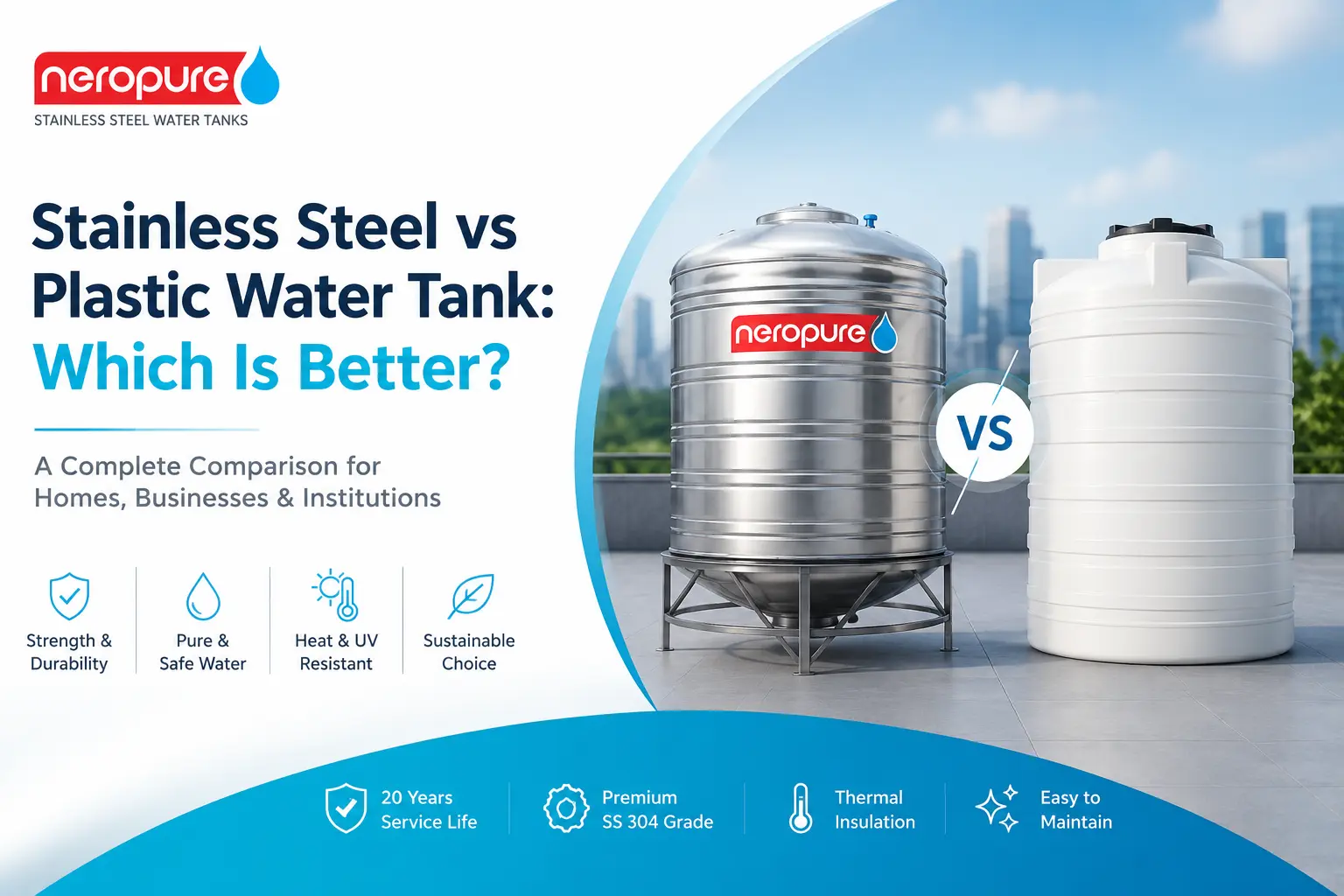
Choosing a water tank often looks like a simple capacity decision: 500 litres, 1,000 litres, 2,000 litres or something larger. In reality, the material you choose can be just as important as the capacity.
For decades, plastic water tanks have been a familiar sight on Indian rooftops because they are affordable, lightweight and widely available. Stainless steel water tanks, however, are increasingly considered by homeowners, architects, builders and commercial users looking for a more durable and long-term water storage solution.
So, when comparing a stainless steel vs plastic water tank, which one is actually better?
There is no honest answer based on material name alone. A good water tank should be evaluated according to its construction quality, water compatibility, installation environment, capacity, insulation, maintenance requirements and expected service conditions.
However, if your priorities are long-term durability, structural strength, hygienic storage, recyclability and a premium water-storage system, a properly specified stainless steel water tank can offer significant advantages. Plastic remains attractive when lower initial cost, lighter weight and simple handling are the dominant considerations.
Let’s understand the differences before deciding.
At a glanceStainless Steel vs Plastic Water Tank: Quick Comparison
| Factor | Stainless Steel Water Tank | Plastic Water Tank |
|---|---|---|
| Initial investment | Generally higher | Generally lower |
| Structural strength | High | Suitable when correctly designed and installed |
| Weight | Heavier | Lightweight |
| Long-term durability | Potentially excellent with correct grade and conditions | Depends strongly on material quality, UV exposure and usage |
| Corrosion | Highly resistant when the appropriate stainless grade is selected | Does not rust |
| Hygiene | Smooth, cleanable stainless surface | Depends on tank quality, design and cleaning |
| UV considerations | Metal itself is not degraded like polymer by UV | UV stabilization and tank quality are important |
| Insulation | Depends on tank construction; multilayer/insulated models available | Polymer has inherently lower thermal conductivity than bare metal, but actual performance depends on construction |
| Maintenance | Relatively straightforward with appropriate tank design | Regular inspection and cleaning still required |
| Recyclability | Stainless steel is highly recyclable | Depends on polymer and recycling infrastructure |
| Upfront affordability | Lower advantage | Strong advantage |
| Premium applications | Strong option | Primarily value/conventional applications |
Stainless Steel
Generally higher
Plastic
Generally lower
Stainless Steel
High
Plastic
Suitable when correctly designed and installed
Stainless Steel
Heavier
Plastic
Lightweight
Stainless Steel
Potentially excellent with correct grade and conditions
Plastic
Depends strongly on material quality, UV exposure and usage
Stainless Steel
Highly resistant when the appropriate stainless grade is selected
Plastic
Does not rust
Stainless Steel
Smooth, cleanable stainless surface
Plastic
Depends on tank quality, design and cleaning
Stainless Steel
Metal itself is not degraded like polymer by UV
Plastic
UV stabilization and tank quality are important
Stainless Steel
Depends on tank construction; multilayer/insulated models available
Plastic
Polymer has inherently lower thermal conductivity than bare metal, but actual performance depends on construction
Stainless Steel
Relatively straightforward with appropriate tank design
Plastic
Regular inspection and cleaning still required
Stainless Steel
Stainless steel is highly recyclable
Plastic
Depends on polymer and recycling infrastructure
Stainless Steel
Lower advantage
Plastic
Strong advantage
Stainless Steel
Strong option
Plastic
Primarily value/conventional applications
The key phrase here is “depends on construction.”
A bare single-wall stainless steel tank and a purpose-built multilayer insulated stainless steel tank should not be treated as identical products. Similarly, not every plastic tank has the same polymer formulation, UV stabilization, wall thickness or manufacturing quality.
That distinction is often missing from simplistic comparisons.
DefinitionsWhat Is a Stainless Steel Water Tank?
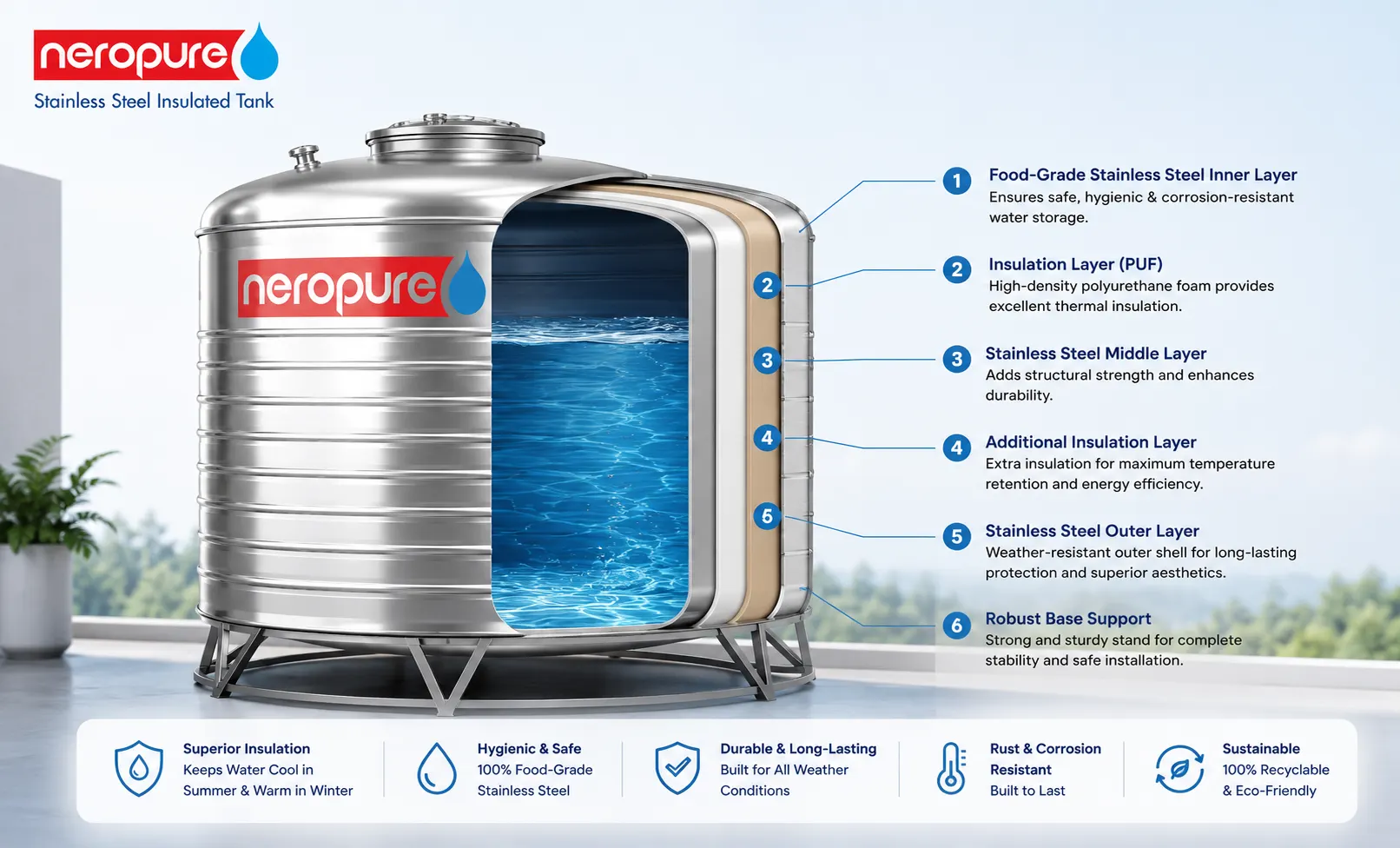
A stainless steel water tank uses stainless steel as a principal structural and water-contact material. Depending on the design, tanks may use different stainless-steel grades and can incorporate multiple protective or insulating layers.
Stainless steel is extensively used in water-related applications because suitable grades combine corrosion resistance, strength, cleanability and durability. World Stainless notes that stainless steel’s corrosion-resistant and relatively inert characteristics make it suitable for contact with drinking water across water-supply applications. World Stainless – Protection of Water
But simply seeing the words “stainless steel” on a tank is not enough.
Buyers should understand the grade of stainless steel, inner and outer construction, water chemistry, insulation system, fabrication quality and intended application.
This becomes particularly important in India, where water characteristics can differ significantly from one location to another.
DefinitionsWhat Is a Plastic Water Tank?
Most conventional plastic water storage tanks are manufactured from polyethylene through processes such as rotational moulding.
Their popularity isn’t difficult to understand. Plastic tanks are relatively lightweight, comparatively inexpensive, widely available and easier to transport and position.
It would be inaccurate to claim that plastic tanks are automatically unsuitable for potable-water storage. India has an established standard—IS 12701—for rotational moulded polyethylene water storage tanks, including tanks intended for potable-water supply. Therefore, quality and compliance matter considerably more than simply labelling every plastic tank “unsafe.” Bureau of Indian Standards
The real question is therefore not:
“Is plastic bad?”
It is:
“Which material and tank construction best meet my water-storage requirements over the period I expect to use it?”
That leads to a much more useful comparison.
Durability and Structural Strength
This is one of the biggest differences between stainless steel and plastic.
Stainless steel provides high structural strength and dimensional stability. A correctly engineered stainless steel tank can therefore be an attractive solution where durability and long-term performance are priorities.
Plastic tanks can perform perfectly well for their intended application, but polymer performance depends on factors such as material quality, wall thickness, manufacturing quality, UV stabilization, installation conditions and prolonged environmental exposure.
For an ordinary homeowner primarily concerned with inexpensive water storage, a good-quality plastic tank may fulfil the requirement.
But for someone evaluating a water tank as a long-term infrastructure component, stainless steel deserves serious consideration.
This distinction becomes even more important for builders, hospitals, hotels, institutions and commercial facilities where tank replacement can involve considerably more than simply purchasing another tank. Downtime, access, plumbing modifications and installation logistics can all contribute to lifecycle costs.
Water Hygiene and Cleanability
Water storage hygiene isn’t determined by tank material alone.
Even the best tank can become unhygienic if the lid is improperly secured, contaminated water enters the tank, sediment accumulates, plumbing is poorly designed or cleaning is neglected.
Stainless steel is widely used in applications where hygiene and cleanability matter. Its corrosion-resistant passive surface is one reason it is employed across water, food-processing and other hygiene-sensitive environments. World Stainless – Stainless Steel for Hygiene
Plastic tanks can also store potable water when appropriately manufactured and maintained. Buyers should therefore look for a tank designed for the intended water-storage application rather than assuming every plastic tank has identical quality.
Regardless of material, regular inspection and appropriate cleaning remain essential.
What Happens Under the Indian Sun?
This comparison requires more nuance than most articles provide.
You may have seen claims that stainless steel automatically “keeps water cooler than plastic.” That statement is too broad.
Bare metal has relatively high thermal conductivity, while polymers generally conduct heat much less readily. Therefore, tank colour, number of layers, insulation, wall construction, exposure duration, ventilation and installation location can matter enormously.
A properly engineered insulated system introduces thermal-resistance layers between the stored water and the external environment, reducing heat transfer.
So if rooftop water temperature is an important consideration, don’t ask only:
“Steel or plastic?”
Ask:
“What is the complete thermal construction of this particular tank?”
That is a much better buying question.
Neropure, for example, offers different stainless steel tank configurations with multilayer and insulated constructions rather than relying only on a bare stainless-steel shell.
Resistance to Corrosion, Rust and Environmental Exposure
Plastic does not rust. That is a legitimate advantage.
Stainless steel, however, is specifically engineered for corrosion resistance through its chromium-containing passive surface. When the correct grade is used in an appropriate environment, that corrosion resistance can provide excellent long-term performance.
But here’s another detail that buyers often aren’t told:
Different grades have different compositions and corrosion-resistance characteristics.
Water chemistry—including factors such as chloride concentration and operating conditions—can influence material selection. Therefore, buyers dealing with challenging water quality should not select a tank solely because its brochure says “SS.”
The correct questions are:
Which stainless-steel grade is used on the water-contact side?
and
Is that construction suitable for my water conditions?
This is especially relevant for projects where borewell water, hard water or unusual water chemistry is involved.
UV Exposure
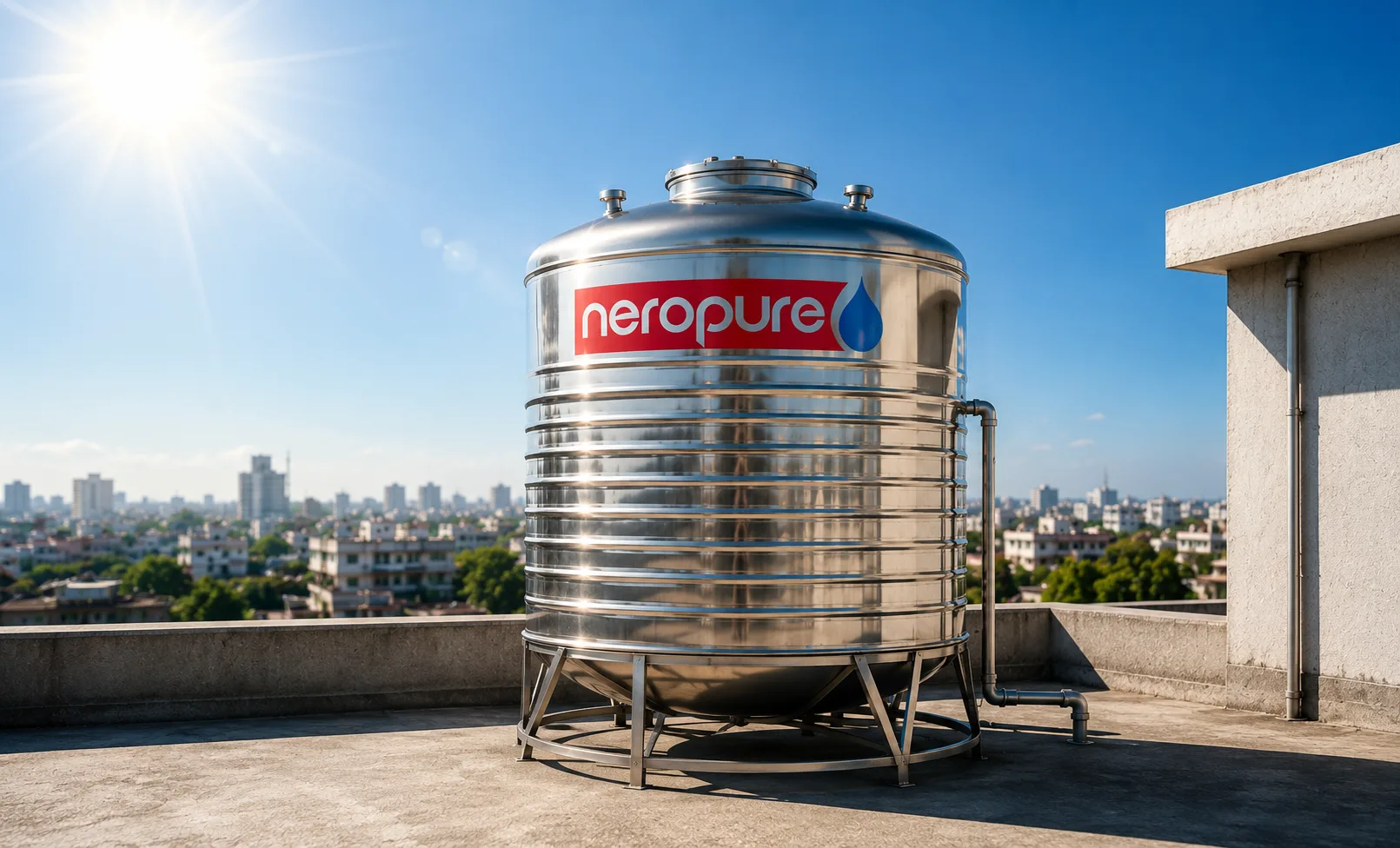
Rooftop tanks in India can spend years exposed to strong sunlight.
Metallic stainless steel does not undergo the same UV degradation mechanism as polymer materials.
Plastic tanks designed for outdoor use can incorporate UV stabilizers, and quality manufacturing matters considerably here. Nevertheless, prolonged environmental exposure is an important consideration when evaluating polymer products.
This does not mean a plastic tank will suddenly fail simply because it sits in sunlight.
Installation and Handling
Here, plastic clearly has an advantage.
Plastic tanks are lightweight relative to stainless steel and are generally easier to transport, lift and position.
This can make installation simpler, especially for residential projects with difficult rooftop access.
Stainless steel tanks require more deliberate handling and installation planning. The base should be stable and level, plumbing connections should be properly executed, and the installation must follow the tank manufacturer’s requirements.
For larger capacities such as 2,000 litres and above, installation planning becomes increasingly important regardless of tank material because water itself is heavy.
Therefore, structural suitability should never be treated casually.
Maintenance
Neither tank is genuinely “maintenance-free.”
That’s another marketing phrase buyers should treat cautiously.
Every water-storage system benefits from periodic:
- inspection
- cleaning
- checking of inlet/outlet connections
- lid inspection
- sediment management
- examination for signs of damage or leakage
Stainless steel’s smooth surface and structural characteristics can make long-term upkeep attractive, but maintenance requirements still depend on water quality, installation and tank design.
Plastic tanks similarly require routine cleaning and inspection.
The better question is therefore:
Which tank is easier to keep in good condition throughout its expected service life?
For buyers prioritizing long-term ownership, this can shift the calculation toward a high-quality stainless steel system.
Initial Cost vs Long-Term Value
This is where plastic usually wins immediately.
A conventional plastic water tank generally requires a significantly lower upfront investment than a well-engineered stainless steel tank.
For buyers with a strict initial budget, that matters.
When evaluating long-term value, consider:
- Expected service life
- Maintenance
- Replacement frequency
- Installation/reinstallation
- Plumbing changes
- Downtime
- Material performance
- Water-storage requirements
A stainless steel tank will normally cost more initially because the raw material, fabrication and—in insulated systems—multilayer construction are fundamentally different.
For perspective, Neropure’s current pricing varies considerably by capacity, model, stainless-steel construction, insulation specification and project requirements. Buyers should therefore obtain a current quotation rather than assume that all stainless steel tanks of the same capacity cost the same.
Sustainability and End-of-Life Considerations
Stainless steel has a particularly strong circularity advantage.
It is highly recyclable, and stainless steel recycling forms an important part of the material’s lifecycle.
Plastic is also recyclable in principle, but practical recyclability depends heavily on polymer type, condition, collection systems and local recycling infrastructure.
For a buyer evaluating a water-storage system over many years, sustainability should therefore consider more than whether the material carries a recycling symbol.
It should include:
That provides a much more realistic environmental comparison.
For homeownersStainless Steel vs Plastic Water Tank: Which Is Better for a Home?
For an Indian homeowner, the answer depends primarily on priorities.
If the biggest priorities are low initial price, low weight, widespread availability and straightforward installation, a good-quality plastic water tank designed for potable-water storage remains a practical option.
If the priorities are long-term durability, structural strength, cleanability, premium construction, recyclability and the availability of engineered insulation systems, stainless steel becomes a compelling alternative.
Homeowners should also consider:
- family size
- daily water consumption
- municipal supply frequency
- backup requirements
- available rooftop space
- water quality
- installation conditions
- required capacity
This is why choosing between materials should come after understanding the requirement, not before it.
For projectsWhat About Commercial Buildings, Hospitals, Hotels and Institutions?
The decision changes somewhat when the tank becomes part of a larger building’s infrastructure.
Commercial and institutional buyers may place greater importance on:
- durability
- hygiene
- maintenance accessibility
- lifecycle performance
- water-contact material
- engineering specifications
- long-term reliability
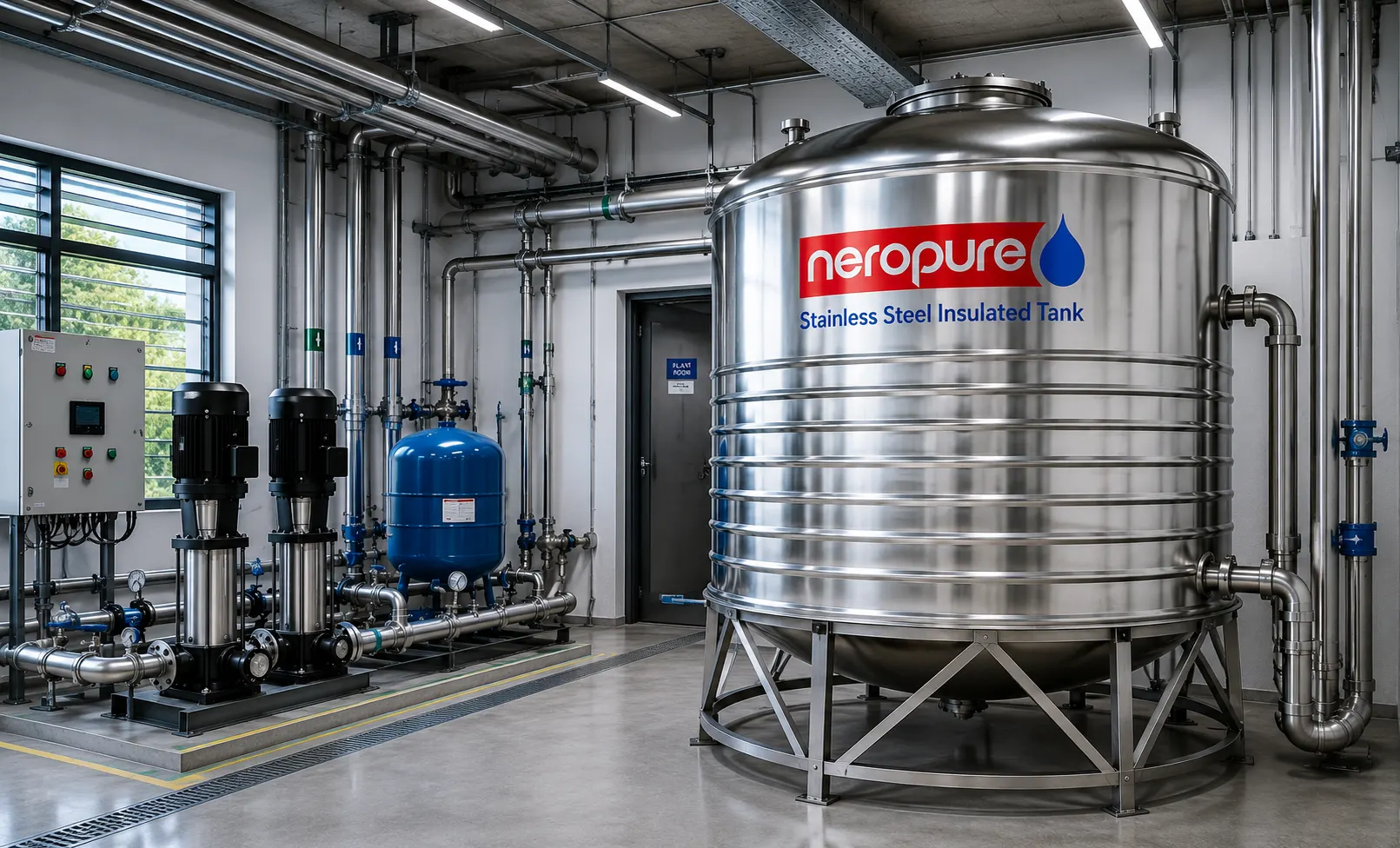
Architects, MEP consultants, developers and facility managers should therefore evaluate the tank as an engineered water-storage component, not simply as a container with a litre rating.
This is also where technical factors such as stainless-steel grade, water TDS/chemistry, insulation, inlet and outlet sizing, overflow configuration, drain arrangement and installation conditions become much more important.
Buyer checklistDon’t Choose a Stainless Steel Tank Based Only on the “SS” Label
This deserves special emphasis.
If you’ve decided that stainless steel is right for your project, don’t stop researching there.
Ask about:
Stainless-steel grade
What material is used for the inner water-contact shell and outer construction?
Water compatibility
Is the tank specification appropriate for the water conditions at your location?
Insulation
Is it single-wall, multilayer or PUF/otherwise insulated?
Capacity
Is the tank correctly sized for your actual consumption and backup requirement?
Construction
What are the inner/outer wall specifications?
Connections
Are inlet, outlet, overflow and drain provisions suitable for your installation?
Installation
What foundation and plumbing conditions are required?
These questions separate an informed purchase from buying a tank based only on appearance.
The verdictSo, Which Is Better: Stainless Steel or Plastic?
There isn’t a universal winner for every buyer.
Plastic water tanks are difficult to beat on upfront affordability, light weight and ease of handling. A properly manufactured tank intended for potable-water storage can be a perfectly legitimate solution.
However, when the buying decision shifts toward long-term durability, structural strength, cleanability, premium construction, recyclability and engineered insulation, a properly specified stainless steel water tank has substantial advantages.
A low-specification stainless steel tank should not automatically be considered superior to every well-designed plastic tank. Equally, comparing a sophisticated multilayer insulated stainless steel system solely on upfront price against a basic plastic tank ignores much of the engineering that determines long-term performance.
For Indian homes and projects, the right decision comes from matching the tank material, grade, construction, insulation and capacity to the actual water-storage requirement.
Choosing the Right Stainless Steel Water Tank with Neropure
Neropure offers stainless steel water-storage solutions across different capacities and configurations for residential, commercial and institutional requirements. Its portfolio includes multiple construction and insulation options, allowing tank selection to be approached according to the application rather than through a one-size-fits-all specification.
Whether you’re evaluating a water tank for a home, residential development, hotel, hospital, school, commercial property or larger project, start by understanding capacity requirements, water conditions, installation environment and expected usage.
The right tank is not simply the one that stores water today. It should be selected to provide dependable water storage throughout its intended working life.
About the author
Neropure Editorial Team
The Neropure Editorial Team writes buying guides and technical explainers on water storage with input from the engineers, production staff and installation crews at our stainless steel tank manufacturing unit in Binola, Gurugram. Every article is reviewed for technical accuracy before it is published and updated when standards, materials or prices change.
Published · Last reviewed
Planning to switch from a conventional plastic tank to a stainless steel water-storage solution?
Enquire Now with Neropure to discuss the appropriate capacity and configuration for your requirements.
Enquire Now