
How to Choose the Right Stainless Steel Water Tank?
Choosing a stainless steel water tank involves more than selecting a capacity. Learn how to evaluate grade, construction, insulation, water quality, installation and long-term value.
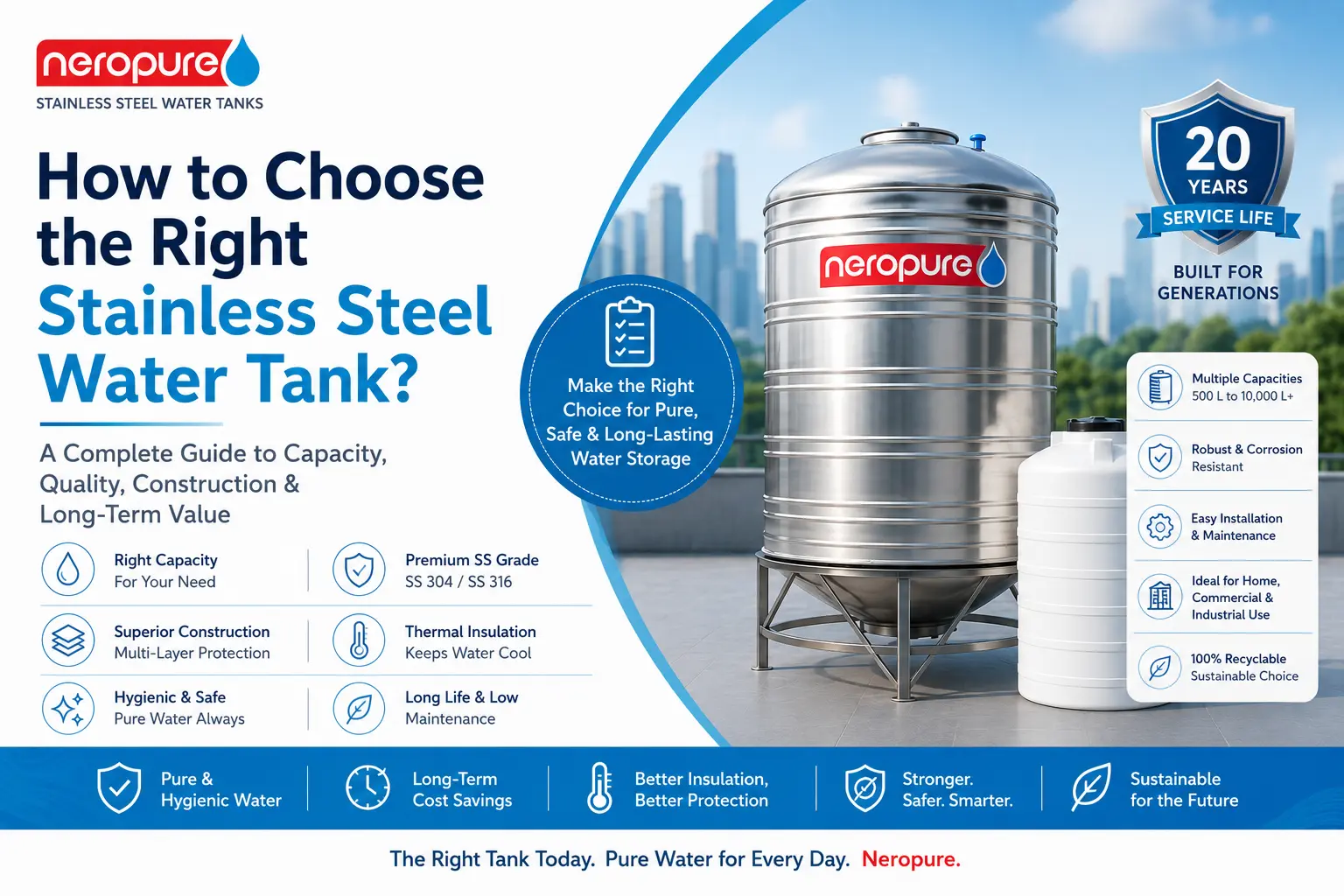
Choosing a stainless steel water tank is not simply a matter of picking a capacity and placing an order. The right tank has to match your water requirement, installation space, water characteristics, stainless steel specification, construction, insulation and intended application.
A 500-litre tank for a home and a 2,000-litre tank for a larger residential or commercial installation may both be called stainless steel water tanks, but their requirements can be very different. Even two tanks with the same capacity may differ in material grade, wall construction, insulation and fittings.
That is why the better question is not “Which stainless steel water tank is best?” but rather:
“Which stainless steel water tank is best suited to my specific requirement?”
This guide explains the factors you should evaluate before choosing an SS water tank, whether you are a homeowner, builder, architect, MEP consultant, contractor, facility manager or institutional buyer.
OverviewWhat Should You Consider When Choosing a Stainless Steel Water Tank?
The right stainless steel water tank should be selected by looking at several factors together rather than focusing on one specification.
Start with your water-storage requirement and required capacity. Then consider the stainless steel grade, tank construction, insulation, dimensions, water quality, installation conditions and connection requirements. Finally, evaluate the manufacturer, warranty, after-sales support and overall value.
For larger projects, structural requirements and engineering specifications also become increasingly important.
In simple terms, the selection process should follow this order:
Let's look at each factor in detail.
Start hereStart With Your Actual Water Storage Requirement
Before comparing tank capacities, understand how much water you actually need to store.
For a home, consider the number of people using the water, approximate daily consumption and how frequently fresh water is supplied. If your local supply is intermittent, you may need more storage capacity than a household with a consistent supply.
The same principle applies to commercial and institutional properties, although the calculation can become considerably more complex.
A hotel may have different consumption patterns from a hospital. A school has different demand from a factory. A residential development may need to account for many occupants and common facilities.
Therefore, don't begin with:
“I want the biggest stainless steel water tank I can fit.”
Begin with:
“How much usable water storage does my building actually require?”
That gives you a more rational starting point.
CapacityChoose the Right Stainless Steel Water Tank Capacity
Once you understand your storage requirement, you can determine the appropriate capacity.
Stainless steel water tanks are available in a wide range of capacities. Smaller tanks can suit individual residential requirements, while larger capacities can be appropriate for apartments, commercial buildings, institutions and industrial facilities.
Common capacities that buyers may evaluate include 500 litres, 1,000 litres, 1,500 litres, 2,000 litres, 3,000 litres and 5,000 litres, with larger systems available for more substantial requirements.
Is a 500-Litre Tank Right for You?
A 500-litre tank may be suitable where the required backup volume is relatively modest or where space is limited.
However, capacity should always be considered against actual consumption and water-supply frequency. A 500-litre tank may be adequate for one application and completely inadequate for another.
When Should You Consider a 1,000-Litre Tank?
A 1,000-litre tank provides substantially more storage and can be considered for households or other applications with greater water requirements.
It can also make sense where water supply interruptions are frequent and additional backup is required.
Is a 2,000-Litre Stainless Steel Water Tank a Better Choice?
A 2,000-litre tank deserves particular consideration when a smaller tank cannot provide sufficient backup.
For larger homes, selected residential developments, offices and other applications, 2,000 litres can provide a useful amount of stored water.
There is, however, an important practical consideration: 2,000 litres of water weighs approximately two tonnes, before accounting for the weight of the tank itself and associated components.
Therefore, if you are planning a 2,000-litre stainless steel water tank on a rooftop or elevated structure, the supporting structure and installation conditions should be properly evaluated.
What About Tanks Above 5,000 Litres?
Once capacity increases substantially, tank selection should increasingly be treated as a project-level engineering decision.
Large commercial, institutional and industrial installations may require consideration of water demand, structural loading, dimensions, access, plumbing, water characteristics and operational requirements.
For these applications, selecting a tank simply by searching for a litre capacity is rarely sufficient.
MaterialCheck the Stainless Steel Grade
One of the most important things to understand is that stainless steel is not a single material.
Different grades have different compositions and performance characteristics. Consequently, the grade used for the water-contact surface can influence the tank's suitability for a particular environment.
Common stainless steel grades encountered in tank applications include 304/304L and 316/316L, among others.
The right grade isn't necessarily the most expensive grade.
Instead, it should be appropriate for the intended application and environmental conditions.
This is especially relevant when the stored water has particular characteristics or when the tank is being installed in a demanding environment.
So, when comparing stainless steel water tanks, don't simply ask:
“Is it stainless steel?”
Ask:
“Which stainless steel grade is used, and where is it used in the tank construction?”
The distinction between the inner water-contact shell and outer shell can also be important.
A professional manufacturer should be able to clearly explain the material specification of the tank being offered.
Build qualityUnderstand the Tank Construction
The stainless steel grade is only one part of the equation.
You also need to understand how the tank is constructed.
A water tank may have different inner and outer shell arrangements, wall thicknesses, insulation layers and connection configurations. These construction differences can affect the tank's weight, thermal behaviour, durability and overall cost.
This is why comparing two tanks based only on:
“Both are 2,000 litres and both are stainless steel.”
isn't enough.
You should understand what you are actually receiving for that capacity.
Ask about:
- Inner shell construction
- Outer shell construction
- Wall thickness
- Insulation layers
- Tank dimensions
- Top-lid construction
- Inlet and outlet configuration
- Overflow arrangement
- Drain provision
These details become particularly important when purchasing for a commercial, institutional or professionally designed project.
Thermal performanceDecide Whether You Need an Insulated Stainless Steel Water Tank
Insulation deserves particular attention for tanks installed in exposed locations.
A tank sitting on a rooftop is exposed to the surrounding environment for long periods. The tank's construction therefore influences how heat moves between the stored water and its surroundings.
But don't make the mistake of assuming that every stainless steel tank behaves in exactly the same way.
A basic single-wall metal tank is fundamentally different from a multilayer insulated stainless steel water tank.
Insulation adds thermal resistance to the tank construction and can help reduce heat transfer.
The effectiveness of the complete system depends on the insulation material, thickness, construction and surrounding conditions.
This is why you should ask:
What type of insulation does the tank use, and how is that insulation incorporated into the overall construction?
Neropure's product range includes different multilayer and insulated configurations, so buyers can evaluate the construction rather than treating every stainless steel tank as an identical product.
Water chemistryConsider Your Water Quality and TDS
The water going into your tank matters.
Municipal water, borewell water and other water sources can have significantly different characteristics. Water chemistry can influence the suitability of different materials and grades, particularly in demanding environments.
Total Dissolved Solids, commonly referred to as TDS, can be one useful indicator when evaluating water characteristics. However, TDS should not be treated as the only factor determining stainless steel grade selection.
A higher TDS reading does not automatically mean that one particular stainless steel grade is universally required. Water chemistry can involve several factors, and material selection should be based on the actual conditions and appropriate technical guidance.
Therefore, if your water source has unusual characteristics or you are dealing with challenging water conditions, share that information with the tank manufacturer before finalising the specification.
Site fitCheck the Tank Dimensions and Available Space
A tank can have the correct capacity and still be unsuitable for your site.
Why?
Because capacity doesn't tell you everything about physical dimensions.
Before selecting a tank, check:
- Diameter or footprint
- Overall height
- Available rooftop or floor space
- Access route
- Maintenance clearance
- Existing plumbing
- Position of other rooftop equipment
This becomes particularly important in urban Indian buildings, where rooftops can already contain solar panels, HVAC equipment, service areas, staircases, parapets and other installations.
A tank that technically fits into a space may still be difficult to install or maintain if adequate access hasn't been considered.
Therefore, don't check only whether the tank will fit.
Check whether it can be installed, connected, inspected and maintained comfortably and safely.
Structural planningConsider Installation and Structural Requirements
Installation should be considered before purchasing the tank, not after it arrives at the site.
The supporting surface should be suitable for the tank and its filled weight. It should also be appropriately level and capable of distributing the load as required by the installation design.
For larger tanks, structural considerations become even more important.
Consider a 2,000-litre tank again. The stored water alone weighs approximately two tonnes. A larger capacity means a correspondingly greater water load.
Architects, MEP consultants, builders and contractors should therefore consider the tank as part of the building's overall water-storage and structural planning.
Installation also involves:
- Tank positioning
- Base/foundation requirements
- Plumbing connections
- Inlet and outlet arrangement
- Overflow
- Drainage
- Access for maintenance
If you are replacing an existing tank, check whether the new tank's dimensions and connection positions can integrate with the existing system.
PlumbingCheck the Inlet, Outlet, Overflow and Drain Configuration
These details can easily be overlooked during product comparison.
A water tank needs to work as part of a plumbing system.
The inlet determines how water enters the tank. The outlet connects stored water to the distribution system. The overflow provides a route for excess water, while a drain point can be useful for maintenance and cleaning.
Before purchasing, confirm that the tank's connection configuration is compatible with your plumbing requirements.
This becomes particularly important for commercial buildings, institutional projects and installations where plumbing layouts have already been designed.
For professionals, connection details should ideally be reviewed alongside the tank's dimensional and technical drawings.
UpkeepThink About Maintenance Before You Buy
No water-storage tank should be treated as completely maintenance-free.
Regular inspection and cleaning remain important regardless of whether the tank is made from stainless steel or another material.
However, tank design can influence how easy it is to inspect and maintain.
When evaluating a stainless steel water tank, consider:
- Access to the tank interior
- Ease of cleaning
- Drain arrangement
- Condition of connections
- Lid/access arrangement
- Potential sediment accumulation
Stainless steel's smooth, cleanable surface is one of the reasons the material is widely used in applications where hygiene and cleanability matter.
But material alone cannot compensate for poor maintenance.
A well-specified tank still needs appropriate cleaning and inspection throughout its service life.
ValueDon't Choose a Stainless Steel Water Tank by Price Alone
Price is obviously an important part of the buying decision.
But it shouldn't be the first—and certainly shouldn't be the only—criterion.
Suppose two manufacturers quote different prices for apparently identical 2,000-litre stainless steel water tanks.
Before choosing the cheaper option, compare the specifications.
- Does each tank use the same stainless steel grade?
- Does each have the same inner and outer construction?
- Does each offer equivalent insulation?
- Are the dimensions comparable?
- Are fittings and connection arrangements equivalent?
- Does the quotation include installation or transportation?
- Does the warranty provide comparable coverage?
Only after answering these questions does the price comparison become meaningful.
For a deeper understanding of how these factors affect the overall investment, see our guide to Stainless Steel Water Tank Price in India.
SupplierEvaluate the Manufacturer, Not Just the Tank
The manufacturer you choose can influence the quality of the overall buying experience.
A professional stainless steel water tank manufacturer should be able to provide clear information about the product being offered.
Look for transparency around:
- Material specification
- Capacity
- Dimensions
- Construction
- Insulation
- Connection details
- Installation requirements
- Warranty
- After-sales support
For a simple residential purchase, this information may seem excessive.
For a large commercial or institutional project, it becomes essential.
A manufacturer that can clearly explain why a particular tank configuration is appropriate for your application is generally more useful than one that simply quotes a capacity and price.
By buyer typeHow to Choose the Right Tank for Different Applications
The “right” stainless steel water tank can look different depending on who is buying it.
For Homeowners
Focus first on daily water requirement, capacity, available space, installation conditions and whether insulation is appropriate for your location.
A homeowner doesn't necessarily need the largest or most technically elaborate tank. The objective is to find a configuration that provides adequate storage without unnecessary investment.
For Builders and Developers
Builders should consider standardisation, capacity planning, dimensions, installation coordination and long-term reliability across the development.
The tank needs to integrate with the building's plumbing and services rather than being selected as an isolated product.
For Architects and MEP Consultants
Technical specifications become much more important.
Material grade, inner and outer construction, dimensions, insulation, connections, drainage and structural considerations should all be evaluated as part of the building design.
For Hotels, Hospitals and Institutions
Reliability, hygiene, capacity, maintenance access and operational requirements can become particularly important.
The water-storage system should be selected according to the facility's actual consumption and operational needs.
For Industrial Facilities
Industrial installations require a more detailed assessment of capacity, water characteristics, material specification, environmental conditions, installation and intended use.
For such projects, manufacturer consultation and project-specific technical evaluation are often preferable to choosing a tank from a generic residential size chart.
Step by stepA Simple Stainless Steel Water Tank Selection Checklist
Before placing an order, work through the decision in sequence.
First
Determine the required water-storage capacity.
Second
Check the available installation space and access.
Third
Confirm the stainless steel grade and water-contact material.
Fourth
Understand the inner and outer tank construction.
Fifth
Decide whether an insulated or multilayer configuration is appropriate.
Sixth
Consider the characteristics of your stored water.
Seventh
Verify inlet, outlet, overflow and drain arrangements.
Eighth
Confirm installation and structural requirements.
Ninth
Compare warranty and after-sales support.
Finally
Compare quotations only after confirming that the specifications are equivalent.
This approach helps prevent one of the most common purchasing mistakes: comparing prices before comparing products.
NeropureWhy Consider Neropure for Stainless Steel Water Storage?
Neropure's stainless steel water tank portfolio includes multiple capacities and configurations, allowing buyers to consider the tank according to their actual application rather than selecting a single universal design.
Its range includes different construction and insulation configurations, with specifications varying across product families. This gives residential, commercial and institutional buyers more parameters to evaluate when selecting a suitable tank.
For someone looking for a stainless steel water tank for home, the focus may be capacity, space and insulation.
For a 2,000-litre requirement, the selection can involve much more than capacity alone.
For larger commercial or institutional requirements, technical specifications, water conditions, dimensions, connections and installation requirements become increasingly important.
ConclusionFinal Thoughts
Choosing the right stainless steel water tank is ultimately an exercise in matching the tank to the application.
Start with how much water you need. Then evaluate capacity, stainless steel grade, construction, insulation, water characteristics, dimensions, installation requirements and connections.
Don't assume that a higher capacity automatically means a better tank, and don't assume that the lowest quotation represents the best value.
Most importantly, don't compare stainless steel water tanks using the words “SS tank” alone.
Look at the actual technical specification behind those words.
For homeowners, the decision may be relatively straightforward. For builders, architects, MEP consultants, contractors, facility managers and institutional buyers, the selection should be approached as part of the overall water-storage design.
Neropure offers multiple stainless steel water tank capacities and configurations to address different water-storage requirements. If you're unsure which capacity or construction is appropriate for your application, Enquire Now to discuss your requirements and identify a suitable solution.
FAQFrequently Asked Questions
How do I choose the right stainless steel water tank?
What size stainless steel water tank do I need for my home?
Is a 2,000-litre stainless steel water tank suitable for a house?
Which stainless steel grade is best for a water tank?
Do I need an insulated stainless steel water tank in India?
Does TDS affect stainless steel water tank selection?
What should I check before buying a stainless steel water tank?
Is a stainless steel water tank worth the investment?
About the author
Neropure Editorial Team
The Neropure Editorial Team writes buying guides and technical explainers on water storage with input from the engineers, production staff and installation crews at our stainless steel tank manufacturing unit in Binola, Gurugram. Every article is reviewed for technical accuracy before it is published and updated when standards, materials or prices change.
Published · Last reviewed
Unsure which stainless steel water tank capacity or construction is appropriate for your application?
Enquire Now to discuss your requirements and identify a suitable solution.
Enquire Now