
What Is an Insulated Water Tank and How Does It Work?
Learn what an insulated water tank is, how thermal insulation works, common insulation materials, benefits, applications and what to consider before choosing one.
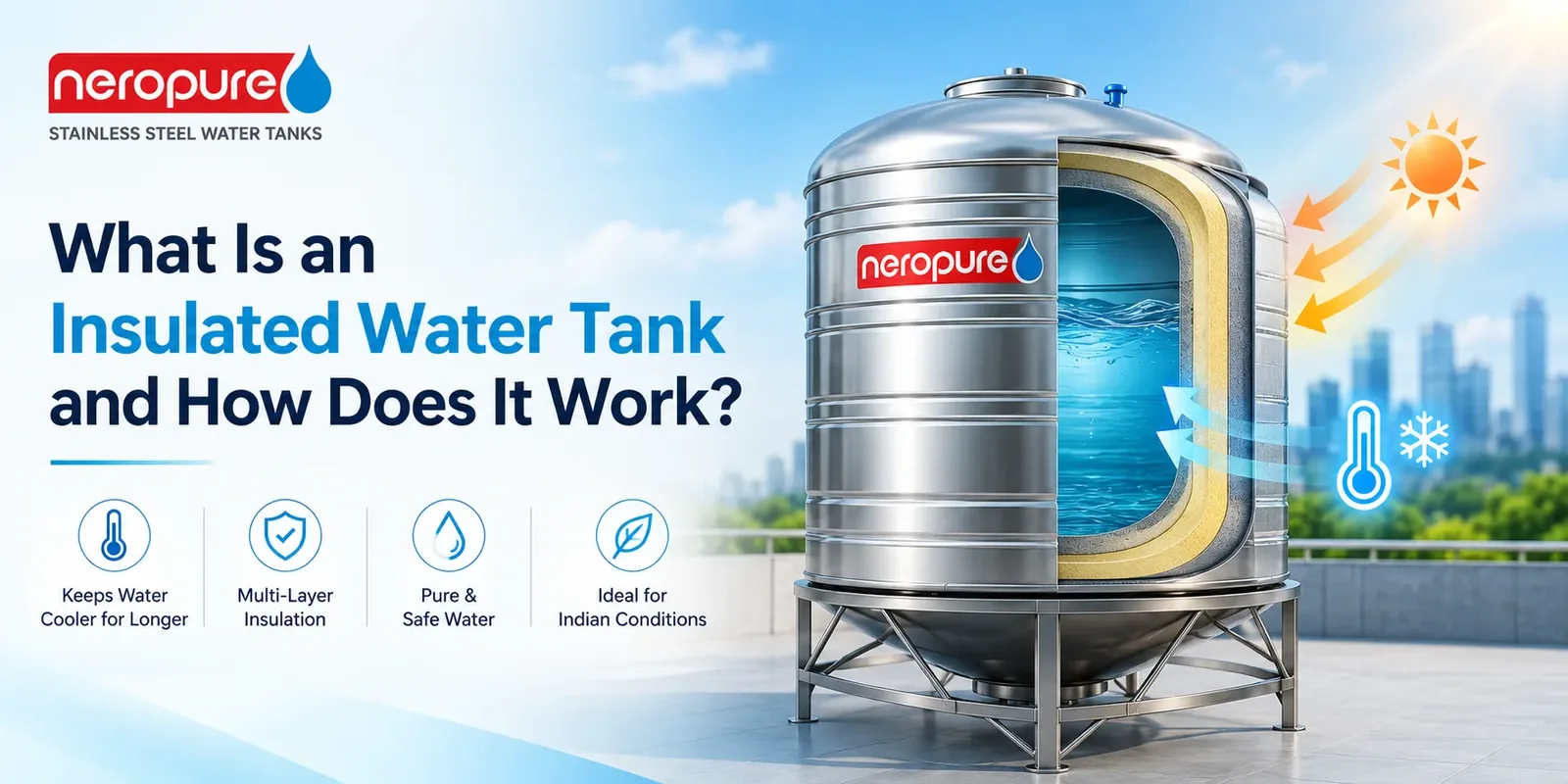
Water stored in a tank does not remain thermally isolated from its surroundings. When the air, roof surface or direct sunlight around a tank becomes hotter or colder than the stored water, heat begins to move between the environment and the tank.
An insulated water tank is designed to slow that process.
It uses one or more thermal insulation layers between—or around—the water-holding vessel and the external environment. These layers increase resistance to heat transfer, helping the stored water change temperature more slowly than it would in a comparable uninsulated tank.
This can be particularly relevant for water tanks installed outdoors or on rooftops and for commercial, institutional and industrial facilities where more stable water-storage conditions are desirable.
However, insulation has limits. It does not refrigerate water, heat water on its own or maintain one exact temperature indefinitely.
Understanding that distinction is the key to understanding how an insulated water tank actually works.
The basicsWhat Is an Insulated Water Tank?
An insulated water tank is a storage tank constructed with a thermal barrier intended to reduce heat transfer between the stored water and the surrounding environment.
A typical insulated tank can contain three broad elements:
- 1An inner vessel or shell that stores the water.
- 2One or more insulation layers around the inner vessel.
- 3An outer protective shell or casing, depending on the tank design.
The exact construction varies considerably between manufacturers and applications.
For example, some tanks use polyurethane foam (PUF) between two structural walls. More advanced designs can combine several materials because individual layers may perform different functions.
The underlying principle remains the same: insulation creates greater resistance to the movement of heat.
This should not be confused with a heated water tank, chiller tank or active temperature-control system. Some industrial insulated tanks form part of systems containing chillers, heaters, pumps or heat exchangers. In those applications, insulation helps preserve the temperature created by other equipment. Insulation itself is passive.ChillerOne
Heat transferHow Does an Insulated Water Tank Work?
To understand an insulated tank, it helps to first understand how heat reaches or leaves stored water.
Heat naturally moves from a region of higher temperature towards a region of lower temperature. The greater the temperature difference, the stronger the tendency for heat to flow.
Three mechanisms are involved: conduction, convection and radiation.BSEE
Conduction
Conduction is heat transfer through a material.
Imagine a water tank standing on a rooftop during a hot afternoon. As the tank's external surface becomes hot, some of that thermal energy can move through the tank wall towards the cooler water inside.
Metal is a comparatively effective conductor of heat, which is one reason the insulation system surrounding a stainless steel storage vessel matters.
An insulating layer introduces material that is much more resistant to heat flow than the steel shell alone.
Convection
Convection occurs through the movement of fluids such as air and water.
Air around the tank continuously exchanges heat with its exterior surface. Inside the tank, temperature differences can also create movement within the stored water.
Insulation does not eliminate convection inside the water. Instead, it reduces the amount of heat entering or leaving through the overall tank assembly, helping reduce the rate at which external conditions influence the water.
Radiation
Thermal radiation transfers energy without direct physical contact.
For an outdoor tank, the most obvious example is solar radiation. Sunlight can heat an exposed tank considerably, particularly when it receives prolonged direct exposure.
The complete tank system—including its exterior surface, insulation and installation conditions—determines how much of that external heat eventually reaches the water.
The key principleHow the insulation layer changes this process
The purpose of insulation is therefore not to "create cold."
It slows heat flow.
When the environment is hotter than the water, an insulated tank can reduce the rate at which heat reaches the stored water. When the environment is colder, the same principle helps slow heat loss from the tank.
That is why a technically accurate description is:
An insulated water tank helps water temperature change more slowly in response to surrounding conditions.
Not:
"An insulated water tank keeps water permanently cold."
Even good insulation cannot eliminate heat transfer completely.
ConstructionHow Is an Insulated Water Tank Constructed?
There is no single universal construction for every insulated water tank.
The appropriate configuration depends on factors including water quality, storage volume, installation environment, required thermal performance and the application.
A typical system may include the following.
| Component | Primary function |
|---|---|
| Inner shell | Holds the stored water |
| Thermal insulation | Resists heat transfer |
| Supporting/protective layers | Provide additional thermal or mechanical functions depending on design |
| Outer shell | Protects the insulation and tank assembly |
| Lid and fittings | Enable filling, withdrawal, overflow, ventilation, draining and maintenance |
Primary function
Holds the stored water
Primary function
Resists heat transfer
Primary function
Provide additional thermal or mechanical functions depending on design
Primary function
Protects the insulation and tank assembly
Primary function
Enable filling, withdrawal, overflow, ventilation, draining and maintenance
Inner shell
The inner shell is the surface in direct contact with stored water.
In stainless steel tanks, the appropriate grade should be selected according to the water characteristics and intended application—not simply because one steel grade sounds "higher" than another.
Neropure's current ranges use different stainless-steel specifications according to product series and application. The current Comfort Series, for example, is presented as SS 304 with double-wall PUF insulation, while other ranges use different constructions.
Insulation system
The insulation surrounds the inner vessel and increases resistance to heat flow.
Depending on the tank, this may consist of one primary foam layer or several different materials working as a thermal assembly.
Outer shell
The outer shell protects the insulation and contributes to the tank's overall physical construction.
In stainless steel insulated tanks, this also allows the insulation to remain enclosed rather than exposed directly to weather, impact and moisture.
MaterialsWhich Materials Are Used to Insulate Water Tanks?
Several materials can be used in tank insulation. They should not be treated as interchangeable because thermal properties, thickness, installation quality and intended application all matter.
Polyurethane Foam (PUF / PU Foam)
Polyurethane foam is commonly used as thermal insulation because its cellular structure restricts heat transfer.
In tank construction it can be injected into a cavity between walls, creating a continuous insulation layer when properly manufactured.
Neropure's current Comfort Series specifically describes double-wall PUF insulation water tanks.
The supplied Neropure technical brochure also documents machine-injected PUF in several tank constructions and describes PUF-based insulation used for thermal protection.
Cross-Linked Polyethylene Foam
Cross-linked PE foam is another insulation material found in multilayer assemblies.
Neropure's current product information shows cross-linked PE foam as part of a more complex insulation build that also includes other supporting layers.Neropure
Nitrile Rubber
Nitrile rubber can also form part of a multilayer thermal system.
It should not automatically be interpreted as the tank's sole insulation material. In a composite design, different layers can perform complementary functions.
Multi-Layer Insulation Systems
Some insulated tanks use several layers rather than relying on one material.
Neropure's current product architecture illustrates this approach with a construction containing an inner stainless steel shell, heat-resistant basecoat, nitrile rubber, cross-linked PE foam, cellulose insulation wrap, laminated vacuum cushion, injected PU foam and stainless-steel outer shell.
This illustrates an important buying principle:
The number of layers by itself does not tell you how well a tank performs.
Thermal performance depends on the materials, thicknesses, continuity of insulation, workmanship and complete construction, not simply whether a product is advertised as "3-layer", "5-layer" or "8-layer".
ComparisonInsulated Water Tank vs Uninsulated Water Tank
The primary difference is resistance to heat transfer.
| Factor | Insulated Water Tank | Uninsulated Water Tank |
|---|---|---|
| Dedicated thermal barrier | Yes | Generally no |
| Heat exchange with surroundings | Reduced by insulation | Greater dependence on tank-wall properties |
| Temperature change | Slower under comparable conditions | Typically responds faster to environmental conditions |
| Construction | Usually more complex | Simpler |
| Initial investment | Can be higher | Often lower |
| Best suited for | Applications where thermal stability has value | Situations where insulation provides little practical benefit |
Insulated Water Tank
Yes
Uninsulated Water Tank
Generally no
Insulated Water Tank
Reduced by insulation
Uninsulated Water Tank
Greater dependence on tank-wall properties
Insulated Water Tank
Slower under comparable conditions
Uninsulated Water Tank
Typically responds faster to environmental conditions
Insulated Water Tank
Usually more complex
Uninsulated Water Tank
Simpler
Insulated Water Tank
Can be higher
Uninsulated Water Tank
Often lower
Insulated Water Tank
Applications where thermal stability has value
Uninsulated Water Tank
Situations where insulation provides little practical benefit
This does not mean an insulated tank is automatically the correct choice for every application.
If a tank is installed in a controlled indoor environment where water temperature has little operational importance, additional insulation may offer limited value.
The decision should follow the application.
You can also read Stainless Steel vs Plastic Water Tank.
BenefitsWhat Are the Benefits of an Insulated Water Tank?
Slower water-temperature fluctuations
This is the core benefit.
Insulation reduces the rate at which external heat reaches the stored water or internal heat escapes from it.
For exposed tanks, this can make stored water less responsive to rapid environmental temperature changes.
Better suitability for rooftop and outdoor installations
Outdoor tanks can face:
- direct solar exposure
- high ambient temperatures
- cold weather
- day-night temperature changes
- wind and changing seasonal conditions
An effective insulated construction provides another layer of thermal protection between those conditions and the stored water.
Greater temperature stability in commercial systems
Commercial and institutional properties often operate water-storage systems at a much larger scale than individual homes.
Hotels, hospitals, educational institutions and large buildings can therefore place greater importance on consistent system performance and correctly engineered tank specifications.
For these applications, insulation becomes one factor within the overall water-storage design rather than simply a comfort feature.
Reduced thermal load in actively heated or cooled systems
This benefit requires an important qualification.
When an insulated storage tank is connected to equipment that actively heats or cools water, reducing unwanted heat transfer can help preserve the temperature produced by that equipment.
Industrial chiller systems are an example: insulated buffer/storage tanks are used to help stabilise chilled-water circulation and limit unwanted thermal gain.
That does not mean every passive rooftop water tank will deliver measurable electricity savings merely because it is insulated.
The system has to actually use heating or cooling equipment for that energy relationship to exist.
ApplicationsWhere Are Insulated Water Tanks Used?
Insulated water tanks can serve very different applications, which is why capacity, material grade and system specification should be selected according to use rather than by applying one standard product everywhere.
Commercial buildings
Commercial properties may require substantial water storage while dealing with exposed plant areas, rooftops and variable environmental conditions.
An insulated stainless steel tank can form part of a wider water-storage system where durability, maintainability and thermal protection are important design requirements.
Hospitals and healthcare facilities
Healthcare facilities require carefully specified water infrastructure.
An insulated tank can help reduce temperature fluctuations, but insulation alone should never be considered a water-safety system.
Water quality in healthcare environments depends on the full system—including incoming water quality, plumbing design, cleaning, disinfection, temperature management and operational controls.
For this reason, tank selection for hospitals should be treated as an engineering and water-management decision rather than a simple product purchase.
Hotels and hospitality
Hotels can have large and variable water requirements throughout the day.
Tank capacity, installation space, turnover, maintenance access and integration with hot/cold water systems may all influence specification.
For tanks exposed to outdoor conditions, insulation can add useful thermal protection.
Industrial facilities
Industrial water-storage requirements vary widely.
Some facilities need general utility water; others may store process water or circulate chilled water.
In process applications, factors such as:
- water chemistry
- required temperature range
- tank material
- insulation thickness
- fittings
- flow rate
- pressure
- cleaning requirements
can become more important than they would be for normal domestic storage.
That is why an industrial insulated water tank should be specified around the actual process.
Educational and institutional buildings
Schools, universities, government buildings and other institutions frequently require centralised water storage for large numbers of occupants.
Insulated tanks may be relevant where storage is exposed to strong outdoor conditions or where temperature stability forms part of the project specification.
Residential buildings
Homes and housing projects are another important application—particularly where water tanks sit directly on roofs exposed to summer heat.
For homeowners, the practical question is usually simpler:
Will insulation meaningfully improve the storage conditions compared with an ordinary tank at this installation location?
That should be evaluated alongside tank capacity, material, water quality, installation and budget.
IndiaWhy Insulated Water Tanks Matter in Indian Conditions
There is no single "Indian climate." Tank conditions in Rajasthan, Kerala, Delhi, Bengaluru or a high-altitude region can differ substantially.
However, many installations across India share one relevant characteristic: water tanks are frequently positioned outdoors or on rooftops.
This can expose them directly to:
- strong solar radiation
- high daytime temperatures
- substantial seasonal variation
- changing day-to-night conditions
Insulation is therefore particularly relevant where the tank will be exposed to a meaningful temperature difference between the stored water and its surroundings.
For Pan-India projects, the appropriate insulation specification should be selected according to the actual site and operating requirement, rather than assuming every region needs exactly the same tank.
LimitationsWhat an Insulated Water Tank Cannot Do
This is just as important as understanding its benefits.
An insulated tank does not:
- actively refrigerate water
- actively heat water unless heating equipment is separately provided
- stop all heat transfer
- guarantee one fixed water temperature
- automatically disinfect stored water
- replace tank cleaning and maintenance
- correct poor incoming water quality
- compensate for incorrect material selection
- compensate for improper installation
Insulation should therefore be viewed as one part of a properly designed water-storage system.
This distinction also prevents a common misunderstanding around hygiene: thermal insulation and hygienic storage are related to different properties of the tank. A tank can have effective insulation and still require appropriate materials, cleaning and contamination controls.
Buying checklistHow to Choose an Insulated Water Tank
A good specification begins with the application—not with the advertised number of layers.
Consider the following factors.
Storage capacity
Determine actual peak and reserve water requirements.
An oversized tank may increase stored-water residence time unnecessarily, while an undersized tank can compromise availability.
Water-contact material
Select the tank material and stainless-steel grade according to the intended water and operating conditions.
This becomes particularly important for industrial, institutional and higher-TDS applications.
Type of insulation
Ask what the manufacturer actually uses.
For example:
- PUF
- PE foam
- nitrile rubber
- composite/multilayer systems
The phrase "insulated tank" alone is not a technical specification.
Insulation thickness
Thickness can influence thermal resistance, but it must be interpreted together with the material being used.
A thicker layer of one insulation material should not automatically be assumed to outperform a different complete system without comparative technical data.
Installation environment
Consider:
- rooftop or ground installation
- indoor or outdoor use
- direct sunlight
- local ambient temperatures
- surrounding structures
- available footprint
- access for installation and maintenance
Tank fittings and flow requirements
Commercial and industrial projects should also specify:
- inlet size
- outlet size
- overflow
- drain
- air vent
- water-level controls where required
These can have a direct operational impact even though they receive much less marketing attention than insulation.
Cleaning and maintenance access
A tank expected to operate for years should be designed with maintenance in mind.
Consider how the tank can be inspected, drained and cleaned rather than evaluating only its initial appearance.
Manufacturer documentation
For commercial or institutional projects, ask for technical documentation relevant to the proposed model.
A specification supported by engineering details is more useful than broad statements such as "advanced insulation" without telling the buyer what the system contains.
NeropureHow Neropure Approaches Insulated Stainless Steel Water Storage
Neropure does not use one identical construction for every requirement.
Its current product range includes different stainless-steel grades, insulation systems and capacities for residential, commercial and industrial applications.
For example, Neropure currently describes its Comfort Series as using food-grade SS 304 construction with double-wall PUF insulation. Its Luxury Series uses a different stainless-steel and multilayer insulation configuration, while its Premium Series targets larger-scale applications including hospitals, factories, pharmaceutical plants and major residential projects.
Neropure's broader product documentation also shows multi-material insulation assemblies incorporating components such as nitrile rubber, cross-linked PE foam and injected PU foam around a stainless-steel inner vessel.Neropure
The supplied technical brochure reinforces this model-specific approach, documenting different construction systems rather than one universal tank specification. It also describes tanks intended for outdoor exposure and configurable capacities for different requirements.
For commercial properties, hospitals, hotels, institutions and industrial projects, this matters because the correct question is not simply:
"Do I need an insulated tank?"
It is:
"What tank material, capacity and insulation configuration does this particular project require?"
That is the specification Neropure should help determine.
FAQFrequently Asked Questions About Insulated Water Tanks
What is an insulated water tank?
How does an insulated water tank work?
Does an insulated water tank keep water cool in summer?
What is PUF insulation in a water tank?
Is a stainless steel insulated water tank suitable for commercial buildings?
Are insulated water tanks suitable for hospitals and hotels?
Is a thicker insulation layer always better?
Is an insulated water tank the same as a chilled-water tank?
ConclusionChoosing the Right Insulated Water Tank for Your Project
An insulated water tank is fundamentally a thermal-control solution for stored water. By slowing heat transfer, insulation can reduce the effect of changing environmental conditions and provide greater temperature stability.
But insulation should never be evaluated in isolation.
For a commercial, institutional or industrial project, the better decision considers the complete system:
That is ultimately what determines whether a water tank is suitable for the job.
About the author
Neropure Editorial Team
The Neropure Editorial Team writes buying guides and technical explainers on water storage with input from the engineers, production staff and installation crews at our stainless steel tank manufacturing unit in Binola, Gurugram. Every article is reviewed for technical accuracy before it is published and updated when standards, materials or prices change.
Published · Last reviewed
Need help specifying an insulated water tank?
Neropure provides insulated stainless-steel water-storage solutions for commercial properties, hospitals, hotels, institutions, industries, builders and residential projects across India.
Submit an enquiry to discuss your capacity, water conditions and project requirements with the Neropure team.
Submit Enquiry